Whole Genome Sequencing (WGS) Services: Precision Solutions for Genetic Discovery
N2Jenomics Lab Pvt. Ltd. provides comprehensive whole genome sequencing (WGS) solutions designed to generate high-quality genomic data across a broad range of organisms. Our flexible and scalable sequencing workflows support research in genetics, genomics, agriculture, microbiology, evolutionary biology, biodiversity, and precision medicine, helping researchers gain valuable insights into genome structure, genetic variation, and biological function.
Key Features
• Broad Sample Compatibility: Supports a wide variety of sample types and species, including plants, animals, microorganisms, and human research samples.
• High-Quality Sequencing Data: Delivers reliable sequencing output with high base-calling accuracy and quality metrics, enabling confident downstream analyses.
• Customized Bioinformatics Analysis: Tailored analytical pipelines are available to meet specific research objectives, from genome assembly and variant detection to functional annotation and comparative genomics.
• End-to-End Project Support: Our experienced scientific team provides consultation, quality control, sequencing, data analysis, and technical assistance throughout the project lifecycle.
• Scalable and Flexible Workflows: Suitable for both small-scale pilot studies and large population-level genomic projects.
• Fast Turnaround Time: Optimized laboratory and computational workflows ensure timely delivery of sequencing results while maintaining high quality standards.
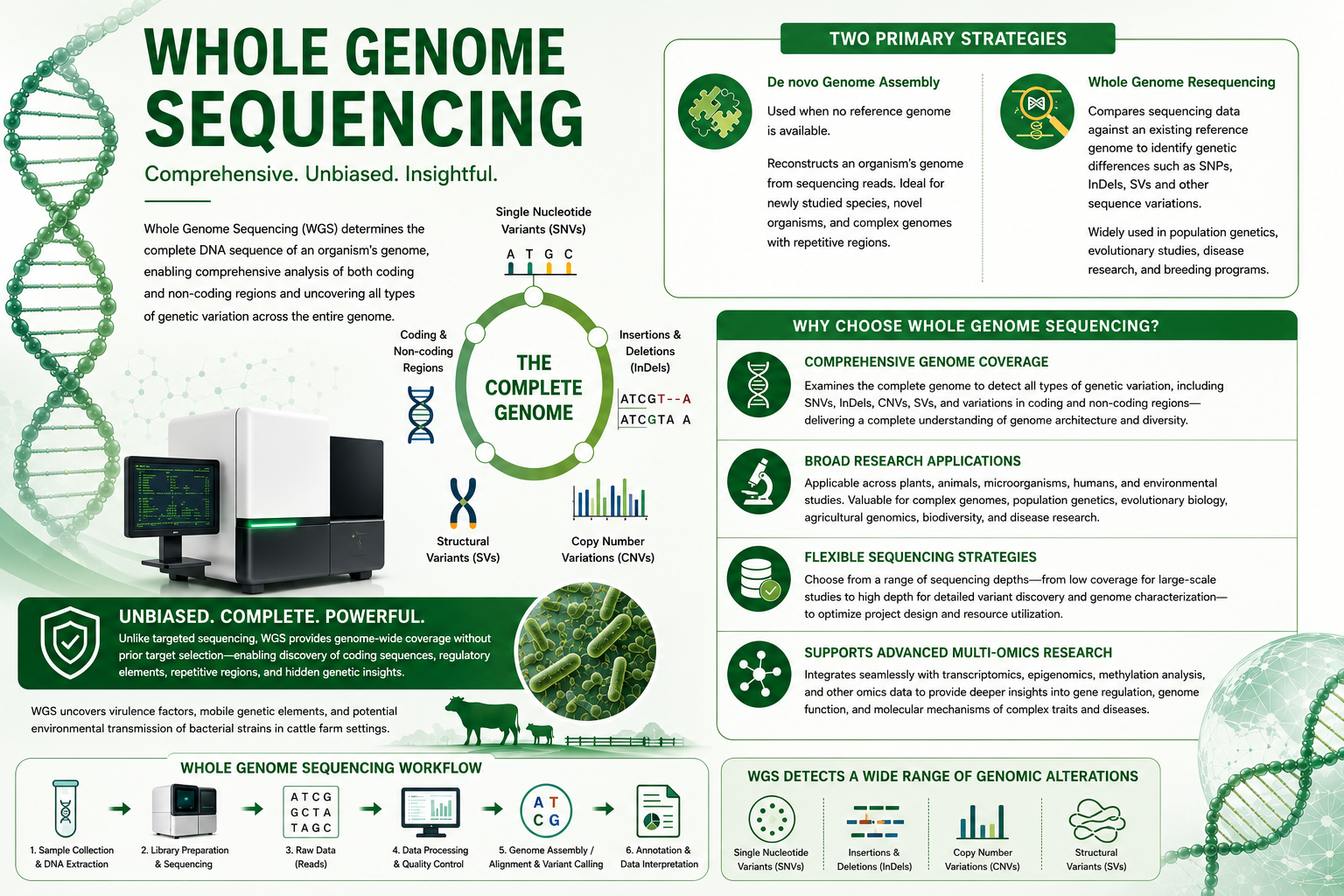
Whole Genome Sequencing (WGS) is an advanced genomic technology that determines the complete DNA sequence of an organism's genome. It enables comprehensive analysis of both coding and non-coding regions, providing a detailed view of genetic variation across the entire genome. WGS can identify a wide range of genomic alterations, including single nucleotide variants (SNVs), insertions and deletions (InDels), copy number variations (CNVs), and structural variants (SVs), making it one of the most comprehensive approaches for genomic research.
Whole Genome Sequencing is commonly performed using two primary strategies:
• De novo Genome Assembly This approach is used when no reference genome is available. It reconstructs an organism's genome from sequencing reads, making it especially valuable for newly studied species, novel organisms, and complex genomes with repetitive regions.
• Whole Genome Resequencing This method compares sequencing data against an existing reference genome to identify genetic differences such as single nucleotide polymorphisms (SNPs), InDels, structural variants, and other sequence variations. It is widely used for population genetics, evolutionary studies, disease research, and breeding programs.
Unlike targeted sequencing methods that focus on selected genomic regions, Whole Genome Sequencing provides comprehensive, genome-wide coverage without prior target selection. This unbiased approach enables researchers to investigate coding sequences, regulatory elements, repetitive regions, and other genomic features that may play important roles in biological function and genetic diversity.
Whole genome sequencing uncovers virulence factors, mobile genetic elements, and potential environmental transmission of bacterial strains in cattle farm settings.
Why Choose Whole Genome Sequencing?
• Whole Genome Sequencing (WGS) has become a powerful and widely adopted technology in modern genomics because it provides a comprehensive, unbiased view of the entire genome. By analyzing all genomic regions in a single experiment, WGS enables researchers to investigate genetic variation with high resolution and supports a broad range of research applications across life sciences.
• Comprehensive Genome Coverage
Unlike targeted sequencing approaches that focus on selected genomic regions, WGS examines the complete genome, allowing simultaneous detection of multiple types of genetic variation, including:
- Single nucleotide variants (SNVs)
- Insertions and deletions (InDels)
- Copy number variations (CNVs)
- Structural variants (SVs)
- Variations within coding and non-coding genomic regions
This comprehensive approach helps researchers obtain a more complete understanding of genome architecture and genetic diversity.
• Broad Research Applications
Whole Genome Sequencing can be applied across a wide range of organisms and research disciplines, including plants, animals, microorganisms, human research, and environmental studies. It is particularly valuable for investigating complex genomes, repetitive DNA regions, population genetics, evolutionary biology, agricultural genomics, biodiversity studies, and disease-related research.
• Flexible Sequencing Strategies
WGS projects can be designed with sequencing depths appropriate for different research objectives, from large-scale population studies using lower coverage to high-depth sequencing for detailed variant discovery and genome characterization. This flexibility enables researchers to optimize both project design and resource utilization.
• Supports Advanced Multi-Omics Research
Whole Genome Sequencing data can be integrated with complementary genomic and multi-omics datasets, including transcriptomics, epigenomics, methylation analysis, and other functional genomics approaches. Such integrated analyses provide deeper biological insights into gene regulation, genome function, and molecular mechanisms underlying complex traits and diseases.
Limitations of Traditional Techniques
Core Advantages of WGS
Can only detect known SNP sites
Discovers novel rare variants and sample-specific mutations
Ignores non-coding regions and regulatory sequences
Provides whole-genome coverage, including both coding and non-coding areas
Capture efficiency relies on probe design, uneven coverage
Utilizes PCR-Free library preparation, achieving uniformity fluctuation within ±5%
Difficulty in identifying SVs and large segment rearrangements
SV detection accuracy exceeds 95%, ideal for researching complex variations
Whole Genome Sequencing Service Portfolio
At N2Jenomics Lab Pvt. Ltd., we offer a comprehensive portfolio of Whole Genome Sequencing (WGS) services tailored to diverse organisms, research objectives, and project requirements. Our customizable sequencing workflows integrate Illumina short-read, PacBio HiFi, and Oxford Nanopore technologies to deliver high-quality genomic data for variant discovery, genome assembly, comparative genomics, and functional studies.
Whether your project involves human, plant, animal, microbial, or non-model organisms, our experts will recommend the optimal sequencing strategy based on your scientific goals, sample type, and budget.
• Standard Whole Genome Sequencing (WGS)
Best suited for:
- Complete genome characterization
- Variant discovery
- Population genetics
- Functional genomics
Key Features:
- High-quality whole genome sequencing
- Flexible sequencing coverage
- Customizable project design
- Suitable for diverse research applications
• Whole Genome Resequencing
Best suited for:
- Reference genome-based studies
- Genome-wide variant detection
- Comparative genomics
- Population genomics
Key Features:
- Identification of SNVs, InDels, CNVs, and structural variants (SVs)
- Accurate comparison against an existing reference genome
- Comprehensive variant analysis
- Flexible sequencing depth
• Plant & Animal De Novo Genome Sequencing
Best suited for:
- Species without a reference genome
- Chromosome-level genome assembly
- Genome annotation
- Evolutionary and agricultural genomics
Key Features:
- Reference-independent genome assembly
- Multi-platform sequencing integration
- High-quality chromosome-scale assemblies
- Comprehensive genome characterization
• De Novo Whole Genome Sequencing
Best suited for:
- Novel organism genome assembly
- First-time genome characterization
- Comparative and evolutionary genomics
Key Features:
- Complete genome reconstruction without a reference genome
- High-contiguity genome assemblies
- Structural genome analysis
- Functional annotation support
• Human Whole Genome Sequencing (PacBio HiFi)
Best suited for:
- Comprehensive human genome analysis
- Structural variant detection
- Rare disease research
- Clinical and translational genomics
Key Features:
- PacBio HiFi long-read sequencing
- High base-level accuracy
- Superior resolution of repetitive genomic regions
- Detection of complex structural variants and phased haplotypes
• Bacterial Whole Genome Sequencing
Best suited for:
- Microbial genome assembly
- Pathogen characterization
- Antimicrobial resistance research
- Comparative genomics
Key Features:
- Complete bacterial genome sequencing
- Strain identification and typing
- Genome annotation
- Comparative genomic analysis
• Fungal Whole Genome Sequencing
Best suited for:
- Fungal genome assembly
- Functional genomics
- Evolutionary biology
- Industrial and agricultural research
Key Features:
- High-quality fungal genome assemblies
- Comparative genomic analysis
- Genome annotation
- Biodiversity and phylogenetic studies
• Microbial Whole Genome Sequencing
Best suited for:
- Bacteria, archaea, fungi, and other microorganisms
- Microbial identification
- Comparative genomics
- Pathogen surveillance
Key Features:
- Comprehensive microbial genome characterization
- Taxonomic identification
- Variant discovery
- Microbial diversity and evolutionary analysis
• Low-Pass (Shallow) Whole Genome Sequencing
Best suited for:
- Cost-effective genome screening
- Copy number variation (CNV) analysis
- Population genetics
- Large-scale genomic studies
Key Features:
- Low-coverage whole genome sequencing
- CNV detection
- Population-scale analysis
- Economical solution for large cohorts
Whole Genome Sequencing Workflow
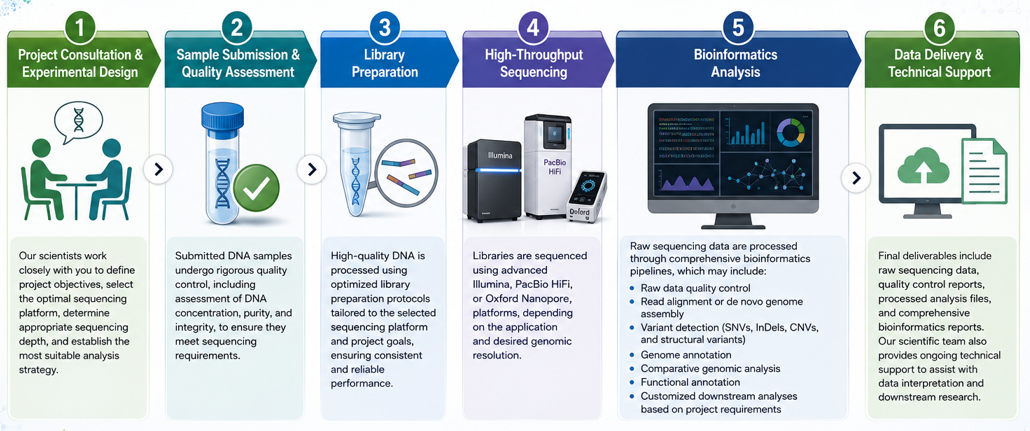
At N2Jenomics Lab Pvt. Ltd., we provide a streamlined, end-to-end Whole Genome Sequencing (WGS) workflow designed to deliver accurate, reliable, and reproducible genomic data. From project consultation to bioinformatics analysis, every step is optimized to ensure the highest quality results for diverse research applications.
1. Project Consultation & Experimental Design
Our scientists work closely with you to define project objectives, select the optimal sequencing platform, determine appropriate sequencing depth, and establish the most suitable analysis strategy.
2. Sample Submission & Quality Assessment
Submitted DNA samples undergo rigorous quality control, including assessment of DNA concentration, purity, and integrity, to ensure they meet sequencing requirements.
3. Library Preparation
High-quality DNA is processed using optimized library preparation protocols tailored to the selected sequencing platform and project goals, ensuring consistent and reliable performance.
4. High-Throughput Sequencing
Libraries are sequenced using advanced Illumina, PacBio HiFi, or Oxford Nanopore platforms, depending on the application and desired genomic resolution.
5. Bioinformatics Analysis
Raw sequencing data are processed through comprehensive bioinformatics pipelines, which may include:
• Raw data quality control
• Read alignment or de novo genome assembly
• Variant detection (SNVs, InDels, CNVs, and structural variants)
• Genome annotation
• Comparative genomic analysis
• Functional annotation
• Customized downstream analyses based on project requirements
6. Data Delivery & Technical Support
Final deliverables include raw sequencing data, quality control reports, processed analysis files, and comprehensive bioinformatics reports. Our scientific team also provides ongoing technical support to assist with data interpretation and downstream research.
Whole Genome Sequencing Strategies
At N2Jenomics Lab Pvt. Ltd., we offer flexible Whole Genome Sequencing (WGS) workflows that can be tailored to different organisms, sample types, and research objectives. Our sequencing strategies combine advanced library preparation methods, multiple sequencing platforms, and customized bioinformatics pipelines to generate high-quality genomic data.
Sequencing Platforms
• Illumina NovaSeq Series Provides high-throughput paired-end sequencing with excellent accuracy, making it well suited for whole genome resequencing, variant discovery, population genomics, and large-scale research projects.
• PacBio HiFi Sequencing Generates highly accurate long reads that support high-quality de novo genome assembly, haplotype phasing, structural variant detection, and resolution of repetitive genomic regions.
• Oxford Nanopore PromethION Produces ultra-long sequencing reads that facilitate comprehensive genome assembly, characterization of structural variants, repeat-rich regions, and other complex genomic features.
Flexible Sequencing Approaches
Our sequencing workflows can be customized according to the objectives of each project, including:
• Standard Coverage for routine whole genome analysis and variant detection.
• High-Depth Sequencing for enhanced sensitivity and detection of low-frequency variants.
• Low-Pass Whole Genome Sequencing for cost-effective genome-wide screening, copy number analysis, and population studies.
Genome Analysis Workflows
Depending on your research requirements, we offer multiple analytical strategies, including:
• Whole Genome Resequencing
• De Novo Genome Assembly
• Hybrid Assembly using both short-read and long-read sequencing technologies
• Customized bioinformatics analysis and reporting
Library Preparation Options
To maximize sequencing performance and data quality, we provide a range of library preparation methods, including:
• Standard DNA Libraries for routine whole genome sequencing applications.
• PCR-Free Libraries to improve genome coverage uniformity and minimize amplification bias where sample quality permits.
• Long-Insert Libraries optimized for long-read sequencing platforms, enabling improved assembly continuity and characterization of complex genomes.
Compatible Sample Types
Our Whole Genome Sequencing services support a broad range of biological samples, including:
• High-quality genomic DNA
• Whole blood and blood-derived DNA
• Fresh or frozen tissues
• Cultured cells
• Plant and microbial samples
• FFPE-derived DNA (subject to quality assessment)
Our scientific team evaluates every project individually and recommends the most appropriate sequencing platform, coverage depth, library preparation method, and bioinformatics workflow to ensure reliable, high-quality results aligned with your research objectives.
Whole Genome Sequencing Bioinformatics Analysis
At N2Jenomics Lab Pvt. Ltd., we provide comprehensive bioinformatics solutions that transform sequencing data into meaningful biological insights. Our analysis workflows are designed to support projects of varying complexity, from standard data processing to advanced, customized genomic analyses. Each workflow can be tailored to meet the specific objectives of your research.
Standard Bioinformatics Analysis
Our standard analysis pipeline includes essential processing and quality assessment steps to ensure reliable and accurate results:
• Raw Data Quality Assessment and Filtering – Evaluation of sequencing quality followed by removal of low-quality reads and technical artifacts.
• Reference-Based Genome Alignment or De Novo Assembly – Alignment of sequencing reads to a reference genome or assembly of genomes without a reference, depending on project requirements.
• Genome-Wide Variant Identification – Detection of single nucleotide variants (SNVs), insertions/deletions (InDels), copy number variations (CNVs), and structural variants (SVs).
• Sequencing Coverage and Depth Analysis – Comprehensive assessment of genome coverage, sequencing depth, and overall data quality.
• Variant Annotation and Functional Interpretation – Annotation of identified variants using established genomic databases to support downstream biological interpretation.
Advanced & Customized Bioinformatics Solutions
For projects requiring deeper genomic investigation, we offer a range of specialized analytical services that can be customized to your research goals:
• Candidate Gene and Pathway Analysis – Identification of biologically relevant genes and enrichment of functional pathways associated with specific traits or diseases.
• Family-Based and Inheritance Analysis – Evaluation of inheritance patterns, pedigree relationships, and genetic linkage in family-based studies.
• Population Genomics and Diversity Analysis – Assessment of population structure, genetic diversity, allele frequency distribution, population differentiation, and related evolutionary metrics.
• Fusion Gene and Genomic Integration Analysis – Detection of gene fusion events and analysis of viral or other genomic integration sites where applicable.
• Structural Variant Characterization – Comprehensive visualization and interpretation of large genomic rearrangements, copy number changes, and complex structural alterations.
• Custom Bioinformatics Workflows – Development of project-specific analysis pipelines for specialized research applications, integrating advanced computational methods and tailored reporting.
Applications of Whole Genome Sequencing
Whole Genome Sequencing (WGS) is a versatile genomic technology that enables comprehensive analysis of an organism's complete genetic makeup. By providing genome-wide information at high resolution, WGS supports a broad spectrum of research applications across life sciences, agriculture, healthcare, microbiology, and evolutionary biology.
• Population Genetics and Evolutionary Studies
Whole Genome Sequencing enables researchers to investigate genetic diversity, population structure, evolutionary relationships, and natural selection. It is widely used to study species evolution, phylogenetic relationships, migration patterns, and population differentiation.
• Complex Trait and Disease Research
WGS plays an important role in identifying genetic factors associated with complex traits and diseases. It supports applications such as Genome-Wide Association Studies (GWAS), Quantitative Trait Loci (QTL) mapping, and comprehensive variant discovery to better understand genotype–phenotype relationships.
• Plant and Animal Genomics
Whole Genome Sequencing facilitates the development of high-quality reference genomes, identification of genes associated with important agronomic and biological traits, and supports molecular breeding, genetic improvement, and conservation programs in both plants and animals.
• Microbial Genomics and Pathogen Surveillance
WGS is widely applied in microbial research for genome characterization, strain typing, comparative genomics, antimicrobial resistance studies, outbreak investigations, and pathogen surveillance. It provides valuable insights into microbial evolution, epidemiology, and public health research.
• Non-Model Organism Research
For organisms with limited genomic resources, Whole Genome Sequencing enables the generation of reference genomes and comprehensive genetic information. These data support biodiversity studies, ecological research, conservation genetics, and the characterization of previously unstudied species.
• Functional Genomics and Regulatory Element Analysis
By examining both coding and non-coding regions of the genome, WGS provides valuable information for investigating gene function, regulatory elements, genome organization, and other genomic features that influence biological processes and phenotypic traits.
• Detection of Structural Variations and Genomic Insertions
Whole Genome Sequencing enables the identification of large-scale genomic alterations, including structural variants, insertions, deletions, translocations, and other complex rearrangements. It can also support studies involving viral integration sites, transgene insertion analysis, and genome integrity assessment where applicable.
• Precision Genomics and Multi-Omics Research
WGS data can be integrated with transcriptomics, epigenomics, proteomics, metabolomics, and other omics technologies to provide a more comprehensive understanding of biological systems. This integrated approach supports biomarker discovery, functional genomics, precision medicine research, and systems biology investigations.
Sample Requirements for Whole Genome Sequencing
Sequencing Type
Total Genomic DNA Requirement
Minimum Usable Amount
DNA Concentration Requirement
Purity Requirement (OD260/280)
Notes
Whole Genome Sequencing
≥ 500 ng
200 ng
≥ 10 ng/μL
1.8 ~ 2.0
Suitable for routine whole genome sequencing
Whole Genome Sequencing (PCR-Free)
≥ 1 μg
500 ng
≥ 20 ng/μL
1.8 ~ 2.0
Avoids PCR amplification bias, ensures higher data uniformity
Whole Genome Sequencing (PacBio)
≥ 1 μg
—
≥ 80 ng/μL
1.8 ~ 2.0
Ideal for long-read sequencing, requires high DNA concentration
Whole Genome Sequencing (Nanopore)
≥ 5 μg
—
≥ 20 ng/μL
1.8 ~ 2.0
Suitable for ultra-long-read sequencing, requires a large amount of DNA
All DNA samples must undergo purity and concentration testing to ensure sequencing quality.
If you have questions regarding sample preparation or require a custom plan, feel free to contact us anytime for expert assistance.
Why Choose N2Jenomics Lab Pvt. Ltd. for Whole Genome Sequencing?
At N2Jenomics Lab Pvt. Ltd., we combine advanced sequencing technologies, experienced scientific expertise, and comprehensive bioinformatics capabilities to deliver reliable Whole Genome Sequencing (WGS) solutions for research across diverse biological disciplines. Our end-to-end services are designed to provide high-quality data, customized workflows, and dedicated technical support from project planning through final data delivery.
• Advanced Multi-Platform Sequencing
We utilize industry-leading sequencing technologies, including Illumina, PacBio HiFi, and Oxford Nanopore, allowing us to select the most suitable platform—or combine multiple technologies—to meet the specific requirements of each project. This flexible approach supports applications ranging from genome resequencing and variant discovery to high-quality de novo genome assembly.
•High-Quality Genomic Data
Our laboratory follows rigorous quality control procedures throughout sample preparation, sequencing, and data processing to ensure the generation of accurate, reproducible, and research-grade genomic datasets suitable for downstream analysis.
• Comprehensive Support Across Multiple Species
We provide Whole Genome Sequencing services for a broad range of organisms, including humans, plants, animals, microorganisms, fungi, and other non-model species. Our expertise spans diverse genome sizes and complexities, enabling us to support a wide variety of research applications.
• Customized Project Workflows
Every research project has unique objectives. Our scientific team works closely with clients to develop tailored sequencing strategies, library preparation methods, coverage recommendations, and bioinformatics workflows that align with specific experimental goals and budget considerations.
• Integrated Bioinformatics Expertise
Beyond sequencing, we offer comprehensive bioinformatics analysis, including quality assessment, genome assembly, variant detection, annotation, comparative genomics, and customized downstream analyses. Our integrated approach helps transform sequencing data into meaningful biological insights.
• End-to-End Scientific Collaboration
From initial project consultation and experimental design to sequencing, data analysis, interpretation, and final reporting, our dedicated scientists provide continuous technical guidance throughout every stage of the project, ensuring a smooth and efficient research experience.
• Flexible Solutions for Challenging Projects
We support a wide variety of research requirements, including complex genomes, low-input DNA, degraded samples (subject to quality assessment), long-read sequencing applications, structural variant analysis, and specialized genomics studies through customized sequencing and analytical strategies.
• Commitment to Quality and Reliability
Our focus on robust laboratory practices, advanced sequencing technologies, and customer-centric scientific support enables us to deliver dependable, high-quality genomic data that researchers can confidently use to advance their scientific discoveries.
1. What sequencing depth is recommended for Whole Genome Sequencing?
The ideal sequencing depth depends on your research objectives. For most whole genome resequencing studies and routine variant discovery, approximately 30× genome coverage is widely recommended. Projects involving rare or low-frequency variant detection may benefit from deeper sequencing, such as 60× coverage or higher, to improve analytical confidence.
2. Can FFPE samples be used for Whole Genome Sequencing?
Yes. DNA extracted from formalin-fixed paraffin-embedded (FFPE) tissues can be used for WGS, although DNA quality may vary due to fragmentation and chemical modifications. To maximize sequencing performance, we recommend:
• Using freshly prepared tissue sections whenever possible.
• Providing sufficient tissue material for DNA extraction.
• Employing library preparation methods optimized for FFPE-derived DNA.
Our team performs quality assessment before sequencing and recommends the most suitable workflow.
3. Which genetic variants can be identified using Whole Genome Sequencing?
Whole Genome Sequencing enables comprehensive detection of multiple classes of genomic variation, including:
• Single nucleotide variants (SNVs)
• Small insertions and deletions (InDels)
• Copy number variations (CNVs)
• Structural variants (SVs)
• Other genome-wide sequence alterations
Optional downstream annotation and interpretation services are also available to support biological and functional analyses.
4. Can low-input or partially degraded DNA samples still be sequenced?
In many cases, yes. Depending on DNA quantity and quality, specialized low-input and damage-tolerant library preparation workflows may be used. Our scientists evaluate each sample individually and recommend the most appropriate sequencing strategy.
5. How do I select the most suitable sequencing platform?
• Platform selection depends on your research objectives and desired outcomes.
Illumina sequencing is well suited for whole genome resequencing, variant identification, and population-scale studies.
• PacBio HiFi and Oxford Nanopore technologies are preferred for de novo genome assembly, structural variant analysis, and resolving complex genomic regions.
Our technical experts can help determine the most appropriate platform based on your project requirements.
6. How should I determine the appropriate sequencing coverage?
Sequencing coverage should be selected according to the goals of your study.
• Approximately 30× coverage is generally sufficient for routine variant detection.
• Higher coverage or hybrid sequencing approaches may be recommended for complex genomes, structural variation studies, or high-quality genome assembly.
We work closely with researchers to design an optimal sequencing plan that balances data quality, project objectives, and budget.
7. How is the quality of a genome assembly evaluated?
Genome assembly quality is assessed using multiple complementary metrics, including:
• Contig N50 and Scaffold N50 to measure assembly continuity.
• BUSCO analysis to evaluate completeness using conserved single-copy genes.
• Transcriptome or RNA-seq alignment to assess gene representation and assembly accuracy.
• Reference sequence comparisons, when available, to validate structural integrity.
These quality assessments provide confidence in the completeness and reliability of the assembled genome.
8. How are repetitive and highly heterozygous genomic regions resolved?
Repetitive DNA sequences and heterozygous genomes present unique assembly challenges. To improve assembly accuracy, we may employ integrated sequencing strategies that combine:
• High-accuracy short-read sequencing
• Long-read sequencing technologies
• Advanced assembly algorithms and polishing methods
These approaches improve repeat resolution, haplotype phasing, and overall genome assembly quality.
9. How is genome size estimated before sequencing?
Genome size can be estimated using several established approaches, including:
• Published genome databases for previously studied organisms.
• Flow cytometry-based DNA content measurements.
• K-mer frequency analysis using preliminary sequencing data to estimate genome size, repeat content, and heterozygosity.
The appropriate method depends on the organism and project requirements.
10. Can I request sequencing without bioinformatics analysis?
Yes. We offer flexible service options to match different research needs. Clients may choose:
• Sequencing only
• Bioinformatics analysis only
• A complete end-to-end sequencing and analysis solution
11. How will I receive updates on my project?
Every project is managed by a dedicated scientific support team. Clients receive regular progress updates throughout the project, including sample quality assessment, sequencing status, data processing, analysis milestones, and final data delivery.
Address:Registered Office: 138, Patparganj Industrial Area, New Delhi – 110092, India
Operational Address: National Institute of Plant Genome Research (BRIC - NGGF)
Lab No. 206 and 207, Aruna Asaf Ali Marg, P.O. Box No. 10531,
New Delhi – 110067, India