N2Jenomics Lab Pvt. Ltd. provides comprehensive RNA Sequencing (RNA-Seq) services for research applications across bacteria, plants, animals, and human samples. Our end-to-end workflow includes optimized library preparation, high-throughput sequencing, and advanced bioinformatics analysis to generate accurate, reproducible, and publication-ready transcriptomic data.
We tailor the library preparation strategy, sequencing depth, and bioinformatics pipeline to your specific research objectives, sample type, and experimental design.
Key Highlights
• Comprehensive Transcriptome Profiling
Accurately quantify gene expression, identify differentially expressed genes (DEGs), analyze transcript isoforms, and discover novel transcripts across diverse biological systems.
• Flexible Experimental Design
Customized sequencing strategies based on organism, RNA type, sequencing depth, and research goals.
• Advanced Bioinformatics
Comprehensive downstream analysis, including gene expression quantification, differential expression analysis, pathway enrichment, functional annotation, and transcript discovery.
• Publication-Ready Deliverables
Receive raw sequencing data, quality control reports, expression matrices, and comprehensive bioinformatics reports with publication-quality figures and tables.
• Flexible Sequencing Platforms
- Illumina short-read sequencing for accurate gene expression profiling
- Optional long-read sequencing for full-length transcript and isoform analysis
N2Jenomics Lab Pvt. Ltd. provides high-quality RNA Sequencing (RNA-Seq) services for comprehensive transcriptome analysis across bacteria, plants, animals, and human research samples. Our end-to-end solutions combine advanced Illumina short-read and optional long-read sequencing technologies with expert bioinformatics to deliver accurate gene expression profiling, transcript discovery, and functional analysis.
Whether your study involves a reference genome or requires de novo transcriptome assembly, we tailor the experimental design, sequencing strategy, and analysis pipeline to meet your research objectives.
What Is RNA-Seq?
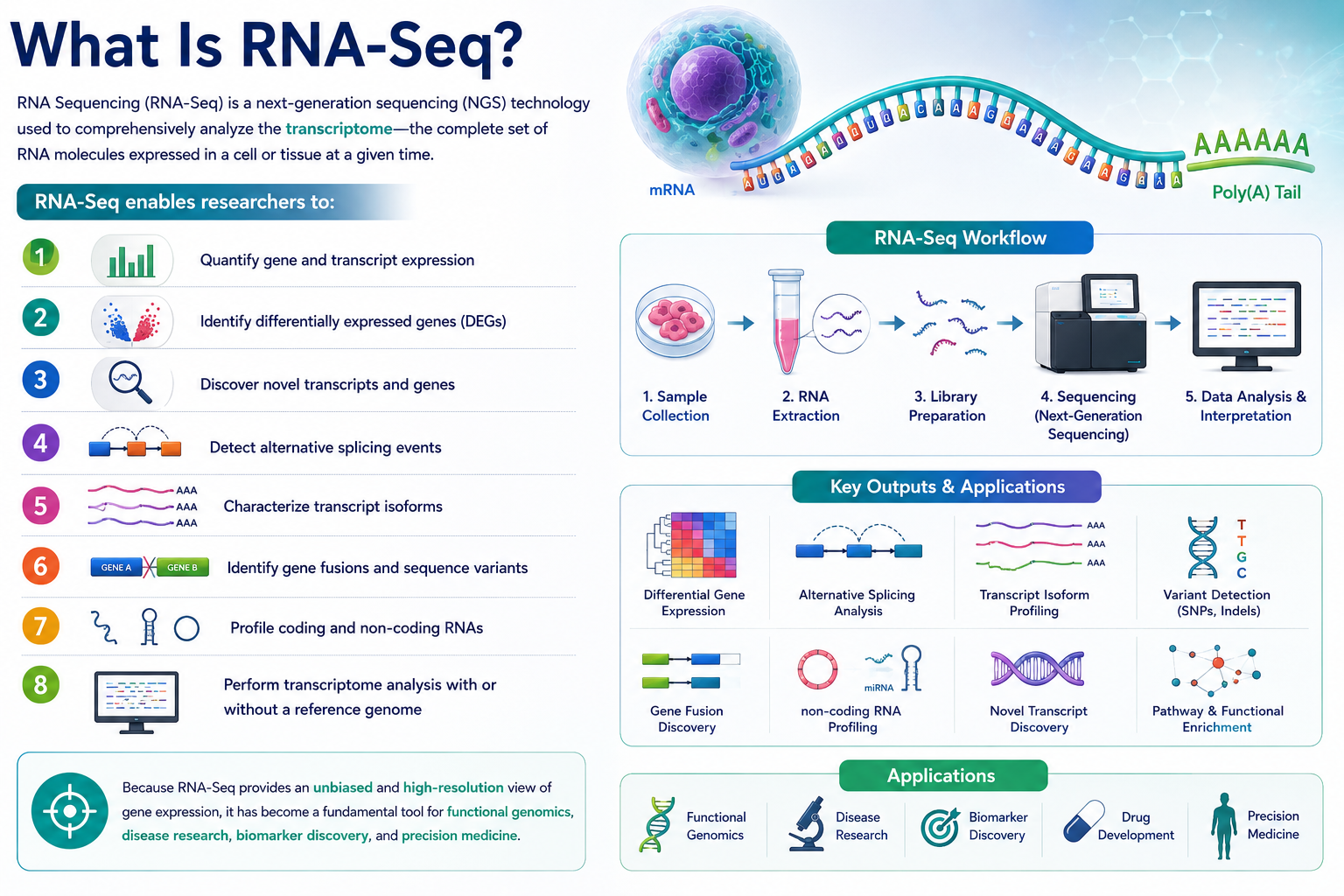
RNA Sequencing (RNA-Seq) is a next-generation sequencing (NGS) technology used to comprehensively analyze the transcriptome—the complete set of RNA molecules expressed in a cell or tissue at a given time.
RNA-Seq enables researchers to:
• Quantify gene and transcript expression
• Identify differentially expressed genes (DEGs)
• Discover novel transcripts and genes
• Detect alternative splicing events
• Characterize transcript isoforms
• Identify gene fusions and sequence variants
• Profile coding and non-coding RNAs
• Perform transcriptome analysis with or without a reference genome
Because RNA-Seq provides an unbiased and high-resolution view of gene expression, it has become a fundamental tool for functional genomics, disease research, biomarker discovery, and precision medicine.
Advantages of RNA-Seq
• Comprehensive Transcriptome Profiling
Simultaneously analyzes coding and non-coding RNAs to provide a complete view of gene expression.
• Accurate Gene Expression Quantification
Measures transcript abundance with high sensitivity and single-base resolution.
• Novel Transcript Discovery
Identifies previously unknown genes, transcript isoforms, alternative splicing events, and gene fusions.
• Reference-Free Analysis
Supports de novo transcriptome assembly for species without an available reference genome.
• Broad Species Compatibility
Suitable for bacteria, plants, animals, humans, and non-model organisms.
• High Throughput & Scalability
Processes multiple samples efficiently with flexible sequencing depths.
• Flexible Sequencing Technologies
- Illumina short-read sequencing for accurate expression profiling
- Optional long-read sequencing for full-length transcript and isoform analysis
RNA-Seq Applications
RNA-Seq is widely used for:
• Gene expression profiling
• Differential gene expression (DEG) analysis
• Novel gene discovery
• Alternative splicing analysis
• Transcript isoform characterization
• Biomarker discovery
• Non-coding RNA research
• Gene function studies
• Comparative transcriptomics
• Population genetics
• Evolutionary biology
• Disease mechanism research
Bulk RNA-Seq vs Cell-Resolved Transcriptomics
The choice between Bulk RNA-Seq and cell-resolved transcriptomics depends on your biological question.
Feature
Bulk RNA-Seq
Cell-Resolved Transcriptomics
Measures
Average gene expression across the sample
Gene expression at single-cell or single-nucleus resolution
Best For
Differential expression, pathway analysis, global transcriptome changes
Resolves individual cell populations and cellular states
Cost & Complexity
Lower
Higher
• Choose Bulk RNA-Seq when your primary question is:
"Which genes or pathways change between experimental conditions?"
• Choose Cell-Resolved Transcriptomics when you want to answer:
"Which specific cell populations are changing, and how do their transcriptional states differ?"
• Bulk RNA-Seq with Computational Deconvolution
When single-cell sequencing is not practical, computational deconvolution can estimate cell-type composition from bulk RNA-Seq data using reference expression profiles. This approach provides valuable insights into tissue heterogeneity while maintaining the simplicity and cost-effectiveness of bulk RNA sequencing.
RNA-Seq Workflow
N2Jenomics Lab Pvt. Ltd. combines both Illumina HiSeq and PacBio systems to provide a fast and accurate RNA-Seq and bioinformatics analysis for any species. Our highly experienced expert team executes quality management, following every procedure to ensure confident and unbiased results. The general workflow for RNA-Seq is outlined below.
Choose the Right RNA-Seq Strategy
Selecting the appropriate RNA-Seq approach depends on your research objectives, sample quality, and transcriptome complexity. N2Jenomics Lab Pvt. Ltd. offers multiple RNA sequencing strategies to support applications ranging from routine gene expression analysis to comprehensive transcript discovery and full-length isoform characterization.
mRNA Sequencing (Poly(A) Enrichment)
Best suited for:
• Gene expression profiling
• Differential gene expression (DEG) analysis
• Pathway enrichment studies
• Coding transcript analysis
• Gene fusion and variant detection in mRNAs
Recommended when:
• High-quality RNA is available
• The primary focus is protein-coding genes
• Non-polyadenylated RNAs are not the main research interest
Deliverables:
• Gene and transcript expression matrices
• Differential expression analysis
• GO and KEGG pathway enrichment (optional)
• Publication-ready reports and figures
Total RNA Sequencing (rRNA Depletion)
Best suited for:
• Comprehensive transcriptome profiling
• Coding and non-coding RNA analysis
• lncRNA and other regulatory RNA studies
• Degraded or partially degraded RNA samples
• Discovery-driven transcriptomics
Recommended when:
• Both polyadenylated and non-polyadenylated RNAs need to be analyzed
For many transcriptomics projects, the most comprehensive approach combines:
• Short-read RNA-Seq for accurate gene expression quantification and differential expression analysis.
• Long-read Iso-Seq for complete transcript structures, isoform identification, and alternative splicing analysis.
This integrated strategy provides both highly accurate expression quantification and full-length transcript resolution, delivering a more complete understanding of transcriptome complexity.
Service Specifications: Sample Requirements, Sequencing & Bioinformatics Analysis
We provide customized bioinformatics analysis including:
Statistics of sequencing depth and coverage
De novo assembly, and reference genome mapping
Gene annotations and gene expression levels
Prediction of novel RNA and identification of variants
Test for differential gene expression
Assessment of allele-specific expression
Identification of expression quantitative trait loci (eQTLs)
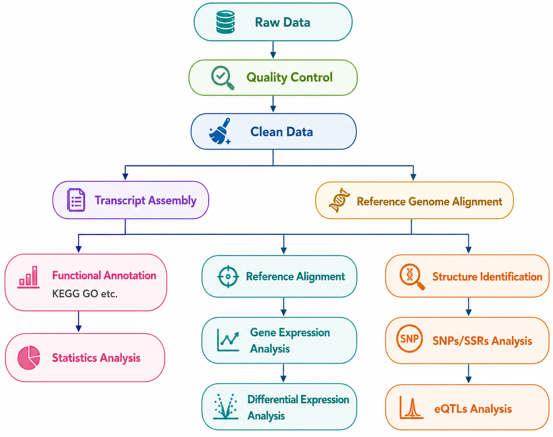
Analysis pipeline
Deliverables
• The original sequencing data
• Experimental results
• Data analysis report
• Details in RNA-Seq for your writing (customization)
Explore More RNA Sequencing Services
In addition to conventional transcriptome RNA-Seq, N2Jenomics Lab Pvt. Ltd. offers a comprehensive portfolio of specialized RNA sequencing services designed to investigate non-coding RNAs, translational regulation, host–pathogen interactions, extracellular vesicle biology, and low-input transcriptomics. These advanced assays provide deeper insights into gene regulation and cellular function across diverse research applications.
• Small RNA Sequencing
Profile small regulatory RNAs—including miRNAs, siRNAs, piRNAs, and other small non-coding RNAs—to investigate gene regulation, development, and disease mechanisms.
• circRNA Sequencing
Identify and quantify circular RNAs (circRNAs) to study back-splicing events, RNA stability, gene regulation, and their potential as disease biomarkers.
• Ribosome Profiling (Ribo-Seq)
Analyze ribosome-protected RNA fragments to measure translation efficiency, identify actively translated regions, and investigate protein synthesis at codon-level resolution.
• Dual RNA Sequencing (Dual RNA-Seq)
Simultaneously profile host and pathogen transcriptomes to explore infection biology, immune responses, and host–microbe interactions.
• Exosomal RNA Sequencing
Characterize RNA cargo within extracellular vesicles (EVs) for liquid biopsy research, biomarker discovery, intercellular communication studies, and precision medicine applications.
• Ultra-Low Input RNA Sequencing
Designed for rare, precious, or low-input samples, enabling reliable transcriptome profiling from limited amounts of RNA without compromising data quality.
• Degradome Sequencing (PARE)
Map miRNA-mediated RNA cleavage sites and validate target genes, making it particularly valuable for plant functional genomics and regulatory RNA research.
• Poly(A) Tail Sequencing (TAIL-Seq)
Measure poly(A) tail length and characterize 3′ end modifications to investigate mRNA stability, translational regulation, RNA degradation, and post-transcriptional gene regulation.lation.
1. How many biological replicates are recommended for RNA-Seq experiments?
For differential gene expression studies, we recommend including at least three biological replicates per experimental condition. Biological replicates improve statistical power, increase confidence in differential expression analysis, and reduce the impact of biological variability. The optimal number of replicates ultimately depends on your experimental design, sample variability, and research objectives.
2. What are the advantages of RNA-Seq over microarray analysis?
RNA-Seq offers several advantages over traditional microarray technology:
• Higher sensitivity and accuracy for gene expression quantification across a wide dynamic range.
• Comprehensive transcriptome coverage, including novel genes, transcript isoforms, splice variants, gene fusions, and low-abundance transcripts.
• No prior sequence knowledge required, making it suitable for both model and non-model organisms.
• Greater reproducibility and reliability, reducing the need for extensive validation compared with microarray-based approaches.
• Simultaneous detection of coding and non-coding RNAs, providing a more complete view of the transcriptome.
3. Why is rRNA depletion or poly(A) enrichment necessary before RNA sequencing?
Ribosomal RNA (rRNA) accounts for more than 80–90% of total cellular RNA. Without rRNA depletion or poly(A) enrichment, most sequencing reads would originate from rRNA, significantly reducing the amount of informative transcriptomic data.
The appropriate enrichment strategy depends on the study objectives:
• Poly(A) enrichment selectively captures polyadenylated mRNAs and is ideal for gene expression studies focusing on protein-coding transcripts.
• rRNA depletion removes ribosomal RNA while retaining both coding and non-coding RNAs, making it suitable for comprehensive transcriptome profiling, degraded RNA samples, and studies involving lncRNAs or other non-polyadenylated transcripts.
4. What is the standard RNA-Seq data analysis workflow?
A typical RNA-Seq bioinformatics workflow includes several key steps:
• Raw sequencing data quality assessment
• Adapter trimming and quality filtering
• Read alignment or transcriptome assembly
• Gene and transcript quantification
• Differential gene expression (DEG) analysis
• Functional annotation
• Gene Ontology (GO) enrichment analysis
• KEGG pathway enrichment analysis
• Alternative splicing and isoform analysis (optional)
• Variant detection (SNP/InDel) and fusion gene analysis (optional)
• The analysis pipeline can be customized based on your research goals and experimental design.
5. How does RNA-Seq differ from DNA sequencing?
Although both technologies use next-generation sequencing, they answer different biological questions.
• DNA sequencing analyzes the genome to identify genetic variants, genome structure, and inherited genetic information.
• RNA-Seq, in contrast, examines the transcriptome—the complete set of RNA molecules expressed in a cell or tissue. It measures gene expression, identifies transcript isoforms and alternative splicing events, and reveals dynamic changes in gene regulation under different biological conditions.
Together, DNA sequencing and RNA-Seq provide complementary insights into genome function and biological processes.
6. Can RNA-Seq identify novel transcripts and splice variants?
Yes. RNA-Seq can identify previously unannotated transcripts, alternative splice variants, gene fusions, and transcript isoforms, particularly when combined with long-read sequencing technologies such as Iso-Seq. This makes RNA-Seq a powerful tool for transcript discovery, genome annotation, and functional genomics research.
Address:Registered Office: 138, Patparganj Industrial Area, New Delhi – 110092, India
Operational Address: National Institute of Plant Genome Research (BRIC - NGGF)
Lab No. 206 and 207, Aruna Asaf Ali Marg, P.O. Box No. 10531,
New Delhi – 110067, India