Skim Sequencing Service: Low-Cost, High-Throughput Genotyping for Agriculture & Research
Skim Sequencing
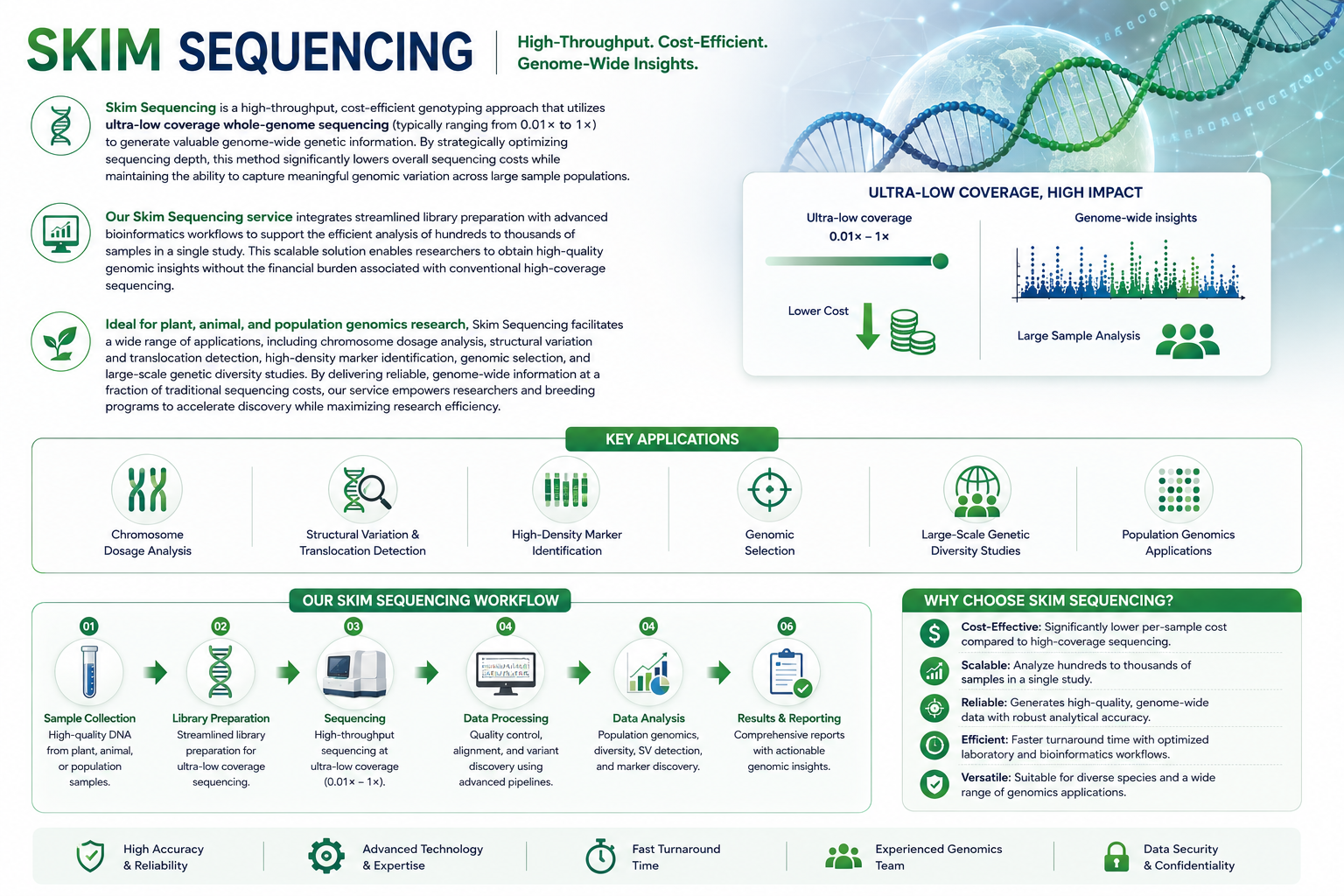
Skim Sequencing is a high-throughput, cost-efficient genotyping approach that utilizes ultra-low coverage whole-genome sequencing (typically ranging from 0.01× to 1×) to generate valuable genome-wide genetic information. By strategically optimizing sequencing depth, this method significantly lowers overall sequencing costs while maintaining the ability to capture meaningful genomic variation across large sample populations.
Our Skim Sequencing service integrates streamlined library preparation with advanced bioinformatics workflows to support the efficient analysis of hundreds to thousands of samples in a single study. This scalable solution enables researchers to obtain high-quality genomic insights without the financial burden associated with conventional high-coverage sequencing.
Ideal for plant, animal, and population genomics research, Skim Sequencing facilitates a wide range of applications, including chromosome dosage analysis, structural variation and translocation detection, high-density marker identification, genomic selection, and large-scale genetic diversity studies. By delivering reliable, genome-wide information at a fraction of traditional sequencing costs, our service empowers researchers and breeding programs to accelerate discovery while maximizing research efficiency.
Skim Sequencing is a cost-effective whole-genome sequencing strategy that generates low-depth genomic data, typically between 0.01× and 1× coverage, for each sample. Rather than targeting specific genomic regions, this approach captures sequencing reads from across the entire genome, providing broad genomic representation suitable for large-scale genetic studies.
Unlike targeted genotyping methods such as Genotyping-by-Sequencing (GBS) or Restriction Site-Associated DNA Sequencing (RAD-seq), which analyze only selected portions of the genome, Skim Sequencing offers genome-wide coverage. When integrated with advanced bioinformatics tools and genotype imputation algorithms, the resulting low-coverage data can be transformed into highly informative datasets for variant discovery, genotype prediction, haplotype reconstruction, and genome-wide analyses.
The increasing affordability of next-generation sequencing has made Skim Sequencing an attractive alternative to conventional high-coverage whole-genome sequencing, particularly for studies involving large sample populations. It delivers a practical balance between cost, scalability, and data quality, enabling researchers to generate comprehensive genomic information while significantly reducing sequencing expenses.
In addition to identifying genome-wide genetic variation, Skim Sequencing supports diverse research applications, including chromosome dosage estimation, structural variation analysis, population genetics, genomic selection, genetic diversity assessment, and marker-assisted breeding. The generated data can also be utilized to investigate organellar genomes and low-copy nuclear genes, making this technology a versatile solution for agricultural, evolutionary, biomedical, and ecological genomics research.
Why Choose Skim Sequencing?
For agribusinesses, research institutions, and conservation programs, skim sequencing represents the optimal balance of data richness, throughput, and budget.
The primary driver for adoption is cost. Skim sequencing reduces the major bottleneck of library construction cost and time through highly multiplexed, low-volume protocols. Furthermore, it provides future-proof data. Unlike arrays, the raw sequence data can be re-analyzed as new genetic questions arise or reference genomes improve, protecting your investment.
Applications of Skim Sequencing in Agricultural Genomics
Our Skim Sequencing service is designed to support modern agricultural research by delivering comprehensive genomic insights that enhance breeding efficiency, crop improvement, and genetic resource management.
• Genomic Selection and Precision Breeding
Accelerate breeding programs by rapidly genotyping large breeding populations. Genome-wide marker data enables accurate prediction of complex traits, helping breeders identify elite parents and high-performing progeny while significantly reducing breeding timelines.
• Genome-Wide Association Studies (GWAS) and QTL Mapping
Generate high-density genomic markers for high-resolution genetic mapping. Our service supports GWAS and quantitative trait locus (QTL) analysis to identify genomic regions associated with key agronomic traits, including yield potential, disease resistance, abiotic stress tolerance, nutritional quality, and other economically important characteristics.
• Introgression Analysis and Backcross Monitoring
Track the inheritance of beneficial genomic regions introduced from donor or wild germplasm with high precision. Skim Sequencing enables efficient monitoring of backcross populations, ensuring the successful incorporation of target traits while preserving the genetic background of elite breeding lines.
• Chromosomal and Structural Genome Analysis
Identify large-scale genomic alterations such as chromosomal rearrangements, copy number variations (CNVs), aneuploidy, and translocations. These analyses are particularly valuable for polyploid crop species and livestock genomics, where structural variations can significantly influence phenotype and breeding outcomes.
• Genetic Diversity and Germplasm Characterization
Characterize breeding materials, germplasm collections, landraces, and wild relatives through comprehensive genome-wide profiling. This approach facilitates the assessment of genetic diversity, discovery of valuable alleles, population structure analysis, and the development of effective conservation and breeding strategies.
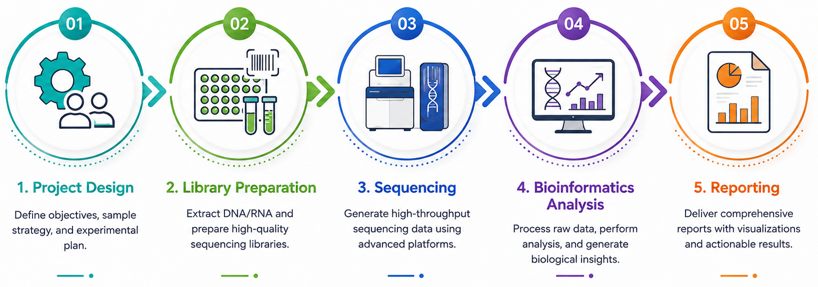
Skim Sequencing Service Workflow
Our streamlined, end-to-end workflow ensures reliability, quality, and rapid turnaround.
Skim Sequencing Bioinformatics Analysis
Our comprehensive bioinformatics workflow converts raw sequencing data into accurate, meaningful, and actionable genomic insights. Using validated analytical pipelines and industry-standard software, we ensure reliable data processing, variant detection, and downstream interpretation for a wide range of research applications.
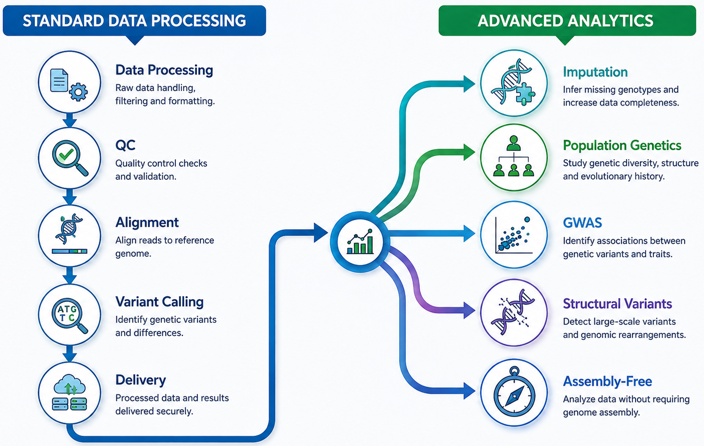
• Standard Data Processing
Our standard analysis package includes all essential processing steps required to generate high-quality genomic datasets:
• Sample demultiplexing and sequencing adapter removal.
• Comprehensive quality assessment using FastQC and MultiQC.
• High-accuracy read alignment against the reference genome using BWA-MEM.
• Genome-wide variant discovery utilizing the Genome Analysis Toolkit (GATK).
• Delivery of processed data files, including FASTQ, BAM, and preliminary VCF files for downstream analyses.
• Advanced Bioinformatics Analysis
For researchers requiring deeper biological insights, we offer a range of advanced analytical modules tailored to diverse genomic studies.
• Genotype Imputation
Enhance the accuracy and completeness of low-coverage sequencing data through advanced genotype imputation. By leveraging reference population haplotypes, missing genetic variants are accurately inferred, substantially improving marker density and analytical power.
• Population Genomics Analysis
Investigate genetic diversity, population structure, ancestry, and evolutionary relationships using established analytical platforms such as PLINK, ADMIXTURE, and other population genetics tools.
• Genome-Wide Association Studies (GWAS)
Identify genomic loci and genetic markers associated with important phenotypic traits through robust statistical association analyses, supporting trait discovery, genomic selection, and molecular breeding programs.
• Structural Variant Analysis
Detect large-scale genomic alterations, including copy number variations (CNVs), inversions, insertions, deletions, and chromosomal translocations using advanced read-depth and split-read analytical approaches.
• Reference-Free Genome Analysis
For species lacking a high-quality reference genome or for complex metagenomic samples, we provide assembly-independent analytical solutions. These methods estimate genomic similarity, classify samples, and evaluate genomic relationships without requiring genome assembly or reference-based alignment.
• Customized Bioinformatics Solutions
Every research project has unique objectives. In addition to our standard workflows, we offer customized bioinformatics analyses designed to meet specific experimental goals. Whether your project involves plant, animal, microbial, or human genomics, our bioinformatics specialists collaborate closely with you to develop tailored analytical strategies and deliver scientifically robust, publication-ready results.
Sample Requirements for Skim Sequencing
To ensure project success, we recommend the following:
Sample Type
Minimum Quantity
Quality Metrics
Genomic DNA
100 ng (for library prep)
A260/A280: 1.8-2.0; A260/A230 >2.0. Intact on gel (high molecular weight).
Plant Tissue
Young leaf tissue (100-200 mg)
Fresh, frozen (in liquid N₂), or preserved in reliable buffer (e.g., CTAB, silica gel).
Animal Tissue
25 mg (e.g., ear notch, blood, semen)
Fresh-frozen or preserved in ethanol. Avoid cross-contamination.
Why Choose N2Jenomics Lab Pvt. Ltd. for Skim Sequencing?
At N2Jenomics Lab Pvt. Ltd., we go beyond delivering sequencing data—we collaborate with researchers to provide reliable genomic solutions that accelerate scientific discovery and innovation. Our expertise, advanced technologies, and customer-focused approach ensure high-quality results from project planning through final data interpretation.
• Scientific Expertise and Advanced Technology
Our Skim Sequencing workflow is built upon well-established, scientifically validated methodologies and supported by advanced sequencing technologies and bioinformatics pipelines. By integrating robust analytical approaches with proven computational tools, we deliver accurate, reproducible, and high-confidence genomic data for diverse research applications.
• Scalable Solutions for Projects of Any Size
Whether your study involves a few hundred samples or large-scale population analyses comprising thousands of samples, our high-throughput infrastructure is designed to deliver consistent data quality with exceptional cost efficiency. Our optimized multiplexing strategies enable rapid processing while maintaining accuracy and reliability across projects of all scales.
• Comprehensive Project Support
Our experienced team of genomics scientists and bioinformatics specialists provides end-to-end assistance throughout every stage of your project. From experimental design and sample planning to advanced bioinformatics analysis and biological interpretation, we offer customized solutions tailored to the requirements of plant, animal, microbial, and other genomic research programs.
• Secure Data Management and Responsible Research
Protecting the confidentiality and integrity of your research data is one of our highest priorities. We follow stringent data security practices and maintain strict confidentiality throughout every project. When required, our bioinformatics workflows can also incorporate additional sequence-screening and quality assurance measures to support responsible genomic research and regulatory compliance.
• Reliable Results with a Customer-Centric Approach
We are committed to delivering accurate data, transparent communication, timely project completion, and responsive technical support. By combining scientific expertise with personalized service, we help researchers transform genomic data into meaningful biological insights that drive innovation in agriculture, biotechnology, life sciences, and related fields.
1. What sequencing coverage is recommended, and how accurate are the results?
The ideal sequencing depth depends on your research objectives and the availability of a high-quality reference genome. For species with well-annotated reference genomes and suitable datasets for genotype imputation, coverage between 0.1× and 0.5× is often sufficient to generate highly reliable genotype information for applications such as genomic selection, population genetics, and genome-wide association studies (GWAS). Projects involving structural variant analysis, complex genomes, or less-characterized species may benefit from 1× or higher coverage. Our genomics specialists will recommend the most appropriate sequencing strategy based on your project requirements.
2. Can Skim Sequencing be performed if my species lacks a complete reference genome?
Yes. Skim Sequencing can still be successfully applied when a fully assembled reference genome is unavailable. In many cases, a draft assembly or the genome of a closely related species provides adequate support for read alignment and variant discovery. For non-model organisms or highly diverse samples, reference-independent analytical approaches can also be employed to assess genetic relationships, estimate genomic similarity, and perform diversity analyses without relying on a complete reference genome.
3. How does Skim Sequencing differ from conventional Whole-Genome Sequencing (WGS)?
Skim Sequencing is a low-coverage whole-genome sequencing approach that offers a highly economical alternative to traditional high-depth WGS. Rather than generating deep coverage for a limited number of samples, it enables genome-wide genotyping across hundreds or even thousands of individuals at a significantly lower cost. For applications such as breeding programs, marker discovery, genomic selection, QTL mapping, and population genetics, Skim Sequencing provides an excellent balance of scalability, affordability, and analytical performance.
4. Can you process field-collected or preserved biological samples?
Yes. Our laboratory is experienced in handling a wide variety of biological sample types collected under both laboratory and field conditions. While high-quality DNA extracted from fresh or properly frozen material generally provides the best sequencing performance, we also support samples preserved using commonly accepted storage methods such as RNA stabilization solutions, silica gel, and other preservation techniques. Our team can recommend suitable sample collection and storage protocols and, where required, provide DNA extraction and quality assessment services before sequencing.
Address:Registered Office: 138, Patparganj Industrial Area, New Delhi – 110092, India
Operational Address: National Institute of Plant Genome Research (BRIC - NGGF)
Lab No. 206 and 207, Aruna Asaf Ali Marg, P.O. Box No. 10531,
New Delhi – 110067, India