High-Throughput NGS Solutions for Functional Genomics and Genome-Wide CRISPR Screening
CRISPR Screen Sequencing combines the power of CRISPR-Cas genome editing with Next-Generation Sequencing (NGS) to enable large-scale functional genomics studies. By simultaneously interrogating thousands of genes, researchers can identify genetic regulators, uncover disease-associated pathways, and discover novel therapeutic targets with unprecedented efficiency.
At N2Jenomics Lab Pvt. Ltd., we provide comprehensive CRISPR screen sequencing services supported by advanced sequencing technologies and specialized bioinformatics. Our end-to-end workflows help researchers accurately quantify sgRNA representation, identify significant genetic perturbations, and transform large-scale screening data into actionable biological insights.
What is CRISPR Screen Sequencing?
CRISPR screen sequencing is a high-throughput approach for systematically investigating gene function across the genome. The workflow begins with the design of a pooled library of single-guide RNAs (sgRNAs) targeting selected genes or genomic regions. These sgRNA libraries are introduced into cells using appropriate delivery systems, where CRISPR-mediated gene perturbations generate diverse genetic populations.
Following experimental selection or phenotypic screening, sequencing is performed to quantify sgRNA abundance. Advanced bioinformatics analyses then identify genes associated with specific biological outcomes, enabling researchers to link genotype with phenotype on a genome-wide scale.
This powerful strategy supports both positive selection and negative selection screens, making it suitable for a wide variety of functional genomics applications.
How CRISPR Screening Works
A typical CRISPR screening experiment includes the following steps:
• sgRNA Library Design – Design or selection of pooled guide RNA libraries targeting genes of interest.
• Library Delivery – Introduction of sgRNA libraries into target cells using optimized delivery methods.
• Experimental Screening – Cells are exposed to defined biological conditions, treatments, or selection pressures.
• Sample Collection – Selected cell populations are harvested based on the experimental phenotype.
• Library Amplification & NGS – sgRNA regions are amplified and sequenced using high-throughput NGS.
• Bioinformatics Analysis – Quantification of sgRNA abundance, statistical analysis, gene ranking, and pathway enrichment are performed to identify biologically significant targets.
Advantages of CRISPR Screen Sequencing
Compared with traditional functional genomics approaches, CRISPR screening offers greater precision, scalability, and reproducibility.
Key advantages include:
• Genome-wide functional gene analysis.
• High-throughput interrogation of thousands of genetic targets simultaneously.
• Accurate quantification of sgRNA abundance using NGS.
• Improved specificity compared with conventional RNA interference (RNAi)-based approaches.
• Identification of essential genes and functional pathways.
• Flexible experimental designs for positive and negative selection studies.
• Scalable workflows suitable for small pilot studies or genome-wide screens.
• Integrated bioinformatics for robust statistical analysis and biological interpretation.
Integrated Sequencing & Bioinformatics
At N2Jenomics Lab Pvt. Ltd., CRISPR screen sequencing is supported by a comprehensive bioinformatics pipeline designed specifically for pooled screening experiments.
Our analysis includes:
• sgRNA extraction and quality assessment.
• Guide RNA count quantification.
• Count normalization.
• Differential enrichment and depletion analysis.
• Statistical identification of significant genes.
• Gene ranking and hit prioritization.
• Functional enrichment analysis.
• Gene Ontology (GO) analysis.
• KEGG pathway analysis.
• Publication-ready visualizations, including volcano plots, heatmaps, enrichment plots, and sgRNA distribution summaries.
These analyses enable researchers to confidently identify genes that drive biological phenotypes and prioritize candidates for downstream validation.
Why Choose N2Jenomics Lab Pvt. Ltd.?
To meet the growing demands of functional genomics research, N2Jenomics Lab Pvt. Ltd. has developed a reliable, cost-effective, and scalable CRISPR screen sequencing platform powered by advanced amplicon-based Next-Generation Sequencing.
Our services provide:
• High-quality sequencing with rigorous quality control.
• Accurate sgRNA quantification and gene-level analysis.
• Comprehensive statistical and pathway enrichment analyses.
• Customized workflows tailored to specific research objectives.
• Publication-ready reports and data visualizations.
• Expert scientific and bioinformatics support throughout your project.
Whether you are conducting genome-wide knockout screens, identifying therapeutic targets, or investigating complex biological pathways, our integrated CRISPR screen sequencing solutions deliver the accuracy, scalability, and biological insight needed to accelerate discoveries in functional genomics, disease biology, biotechnology, and precision medicine.
Applications of CRISPR Screen Sequencing
Accelerating Functional Genomics Through High-Throughput Screening
CRISPR Screen Sequencing enables researchers to investigate gene function on a genome-wide scale by combining pooled CRISPR libraries with high-throughput Next-Generation Sequencing (NGS). This powerful approach provides valuable insights into gene regulation, disease biology, and therapeutic target discovery across a wide range of research disciplines.
Functional Genomics
Understand the biological roles of genes through systematic, large-scale perturbation studies. CRISPR screening allows researchers to identify genes involved in cellular processes, signaling pathways, differentiation, and disease progression.
Applications include:
• Genome-wide loss-of-function and gain-of-function studies
• Identification of essential genes
• Synthetic lethality analysis
• Gene interaction network mapping
• Functional pathway characterization
• Target prioritization for downstream research
Drug Target Discovery
Identify and validate genes that influence disease progression or therapeutic response. High-throughput CRISPR screening helps uncover novel molecular targets that can accelerate drug development and precision medicine research.
Applications include:
• Discovery of therapeutic targets
• Drug resistance mechanism studies
• Biomarker identification
• Target validation for drug development
• Small-molecule sensitivity screening
• Precision medicine research
Disease Model Development
Generate deeper insights into disease mechanisms by identifying genetic factors that drive pathological phenotypes. CRISPR screening supports the development of robust cellular and disease models for translational research.
Applications include:
• Cancer biology and oncology research
• Immunology and inflammatory disease studies
• Neurological disorder research
• Rare genetic disease investigations
• Infectious disease research
• Functional validation of disease-associated genes
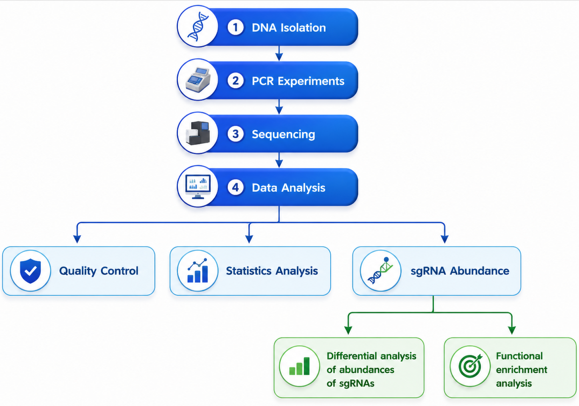
CRISPR Screen Sequencing Workflow
At N2Jenomics Lab Pvt. Ltd., every CRISPR screen sequencing project follows a standardized workflow supported by stringent quality control and advanced bioinformatics. Our integrated approach ensures accurate sgRNA quantification, reliable statistical analysis, and biologically meaningful interpretation.
Step 1: Sample Preparation
• Genomic DNA isolation from screened cell populations
• DNA quality and quantity assessment
• Sample quality control
Step 2: PCR Amplification
• Amplification of sgRNA regions
• Library preparation using optimized protocols
• Library quality assessment
Step 3: Next-Generation Sequencing
• High-throughput sequencing of pooled sgRNA libraries
• High-depth data generation with rigorous quality monitoring
Step 4: Bioinformatics Analysis
Our dedicated CRISPR screening pipeline includes:
• Quality control and read filtering
• sgRNA extraction and quantification
• Read count normalization
• Differential enrichment and depletion analysis
• Statistical identification of significant genes
• Gene ranking and hit prioritization
• Functional enrichment analysis (GO and KEGG)
• Publication-ready visualizations, including volcano plots, heatmaps, and enrichment analyses
Step 5: Biological Interpretation & Reporting
Researchers receive a comprehensive analysis package containing:
• sgRNA count matrices
• Differential abundance reports
• Candidate gene rankings
• Functional enrichment results
• Statistical summaries
• Publication-ready figures and visualizations
• Complete bioinformatics report with scientific interpretation
Service Specifications
Sample Requirements
Samples types: cells or DNA samples after positive/negative selection
DNA sample: ~1.5 μg (concentration ≥ 30 ng/μl; OD260/280=1.8~2.0)
Cell sample: 5×10⁶ cells
Note: Sample amounts are listed for reference only. For detailed information, please contact us with your customized requests.
Sequencing Strategy
Illumina HiSeq platforms
Paired-end 150 bp or 300 bp
Analysis of sequencing quality metrics
Bioinformatics Analysis We provide multiple customized bioinformatics analyses:
Raw data QC
Reference alignment
sgRNA abundance analysis
Differential analysis of abundances of sgRNAs
Note: Recommended data outputs and analysis contents displayed are for reference only. For detailed information, please contact us with your customized requests.
Analysis Pipeline
Deliverables
• The original sequencing data
• Experimental results
• Data analysis report
• Details in CRISPR Screen Sequencing for your writing (customization)
1. How are sgRNA libraries designed for CRISPR screening?
Designing an effective single-guide RNA (sgRNA) library is one of the most important steps in a successful CRISPR screening experiment. A well-designed library maximizes editing efficiency, improves target specificity, and minimizes off-target effects, ensuring reliable genome-wide or targeted functional screening.
Key factors considered during sgRNA library design include:
• Selection of target genes or genomic regions.
• Optimal GC content for efficient guide performance.
• Strategic placement of CRISPR cleavage sites.
• Evaluation of guide RNA secondary structure.
• Prediction of on-target editing efficiency.
• Assessment of guide RNA specificity.
• Identification and minimization of potential off-target sites.
• Avoidance of sequence features that may reduce guide performance or transcription efficiency.
• Careful optimization of these parameters helps generate high-quality sgRNA libraries for robust and reproducible CRISPR screening studies.
2. What types of CRISPR screens can be performed?
CRISPR screening can be customized to address a wide range of biological questions using different experimental designs.
• Positive Selection Screens Identify genes whose disruption provides a survival advantage or resistance under specific experimental conditions, such as drug treatment or environmental stress.
• Negative Selection Screens Identify essential genes by detecting guide RNAs that become depleted because gene disruption reduces cell viability or fitness.
• Pooled CRISPR Screens Thousands of sgRNAs are introduced into a mixed population of cells simultaneously, enabling efficient, high-throughput functional genomics studies.
• Arrayed CRISPR Screens Each sgRNA is tested individually in separate wells or samples, allowing detailed phenotypic characterization and validation of specific genetic targets.
3. How can off-target effects be minimized during CRISPR screening?
Reducing off-target genome editing is essential for obtaining accurate and biologically meaningful screening results. Researchers employ several strategies to maximize editing specificity.
Common approaches include:
• Designing highly specific sgRNAs using advanced computational tools.
• Selecting guide RNAs with low predicted off-target potential.
• Experimentally validating guide RNA performance before large-scale screening.
• Using high-fidelity CRISPR nucleases engineered to reduce unintended DNA cleavage.
• Applying optimized experimental conditions and sequencing-based validation to confirm editing accuracy.
Together, these strategies improve the reliability and reproducibility of CRISPR screening experiments.
4. How is CRISPR screen sequencing data analyzed?
CRISPR screen sequencing generates large-scale datasets that require specialized bioinformatics pipelines to identify biologically significant genetic perturbations.
A typical analysis workflow includes:
• Sequencing Quality Control – Assessing read quality, filtering low-quality reads, and ensuring data integrity.
• Read Processing & Alignment – Identifying and mapping sgRNA sequences to the reference library or genome.
Operational Address: National Institute of Plant Genome Research (BRIC - NGGF)
Lab No. 206 and 207, Aruna Asaf Ali Marg, P.O. Box No. 10531,
New Delhi – 110067, India