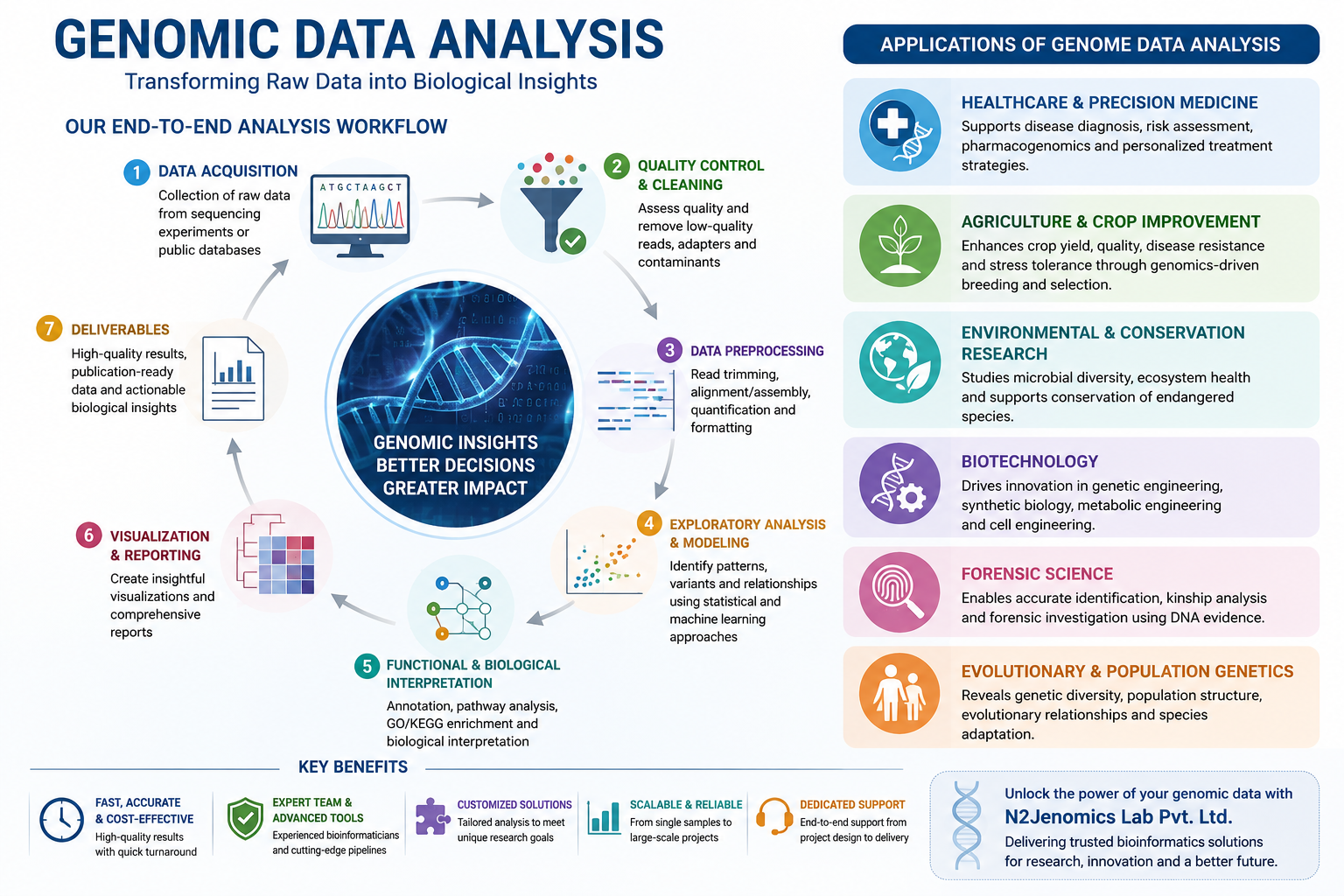
At N2Jenomics Lab Pvt. Ltd., our proprietary GenSeq™ Technology powers comprehensive Genome Data Analysis services, enabling researchers to transform complex sequencing data into meaningful biological insights. Backed by an experienced team of bioinformaticians and computational biologists, we provide robust, accurate, and scalable data analysis solutions for academic institutions, biotechnology companies, healthcare organizations, and contract research projects.
Whether your study involves whole-genome sequencing, transcriptomics, metagenomics, population genetics, or comparative genomics, our end-to-end bioinformatics workflows are designed to deliver reliable, publication-ready results.
What Is Genome Data Analysis
Genome data analysis is the process of processing, interpreting, and extracting biologically meaningful information from genomic sequencing data. It involves the application of advanced bioinformatics tools, computational algorithms, and statistical methods to analyze DNA or RNA sequences and uncover genetic variations, functional elements, and biological relationships.
A genome represents the complete genetic blueprint of an organism, containing both coding and non-coding DNA sequences. Through genome data analysis, researchers can identify genes, characterize genetic variants, study gene regulation, investigate evolutionary relationships, and understand the molecular mechanisms underlying biological traits and diseases.
Genome data analysis has become an essential component of modern life sciences and supports a broad range of applications, including genomics research, precision medicine, agriculture, biotechnology, microbial genomics, and drug discovery.
Key Components of Genome Data Analysis
• Sequence Alignment - High-quality sequencing reads are aligned to a reference genome or assembled de novo to accurately determine their genomic locations, providing the foundation for downstream analyses.
• Variant Detection - Genetic variations including single nucleotide polymorphisms (SNPs), insertions/deletions (Indels), structural variants (SVs), and copy number variations (CNVs)—are identified, filtered, and annotated to understand their biological significance.
• Gene Expression Analysis - RNA sequencing data is analyzed to quantify gene expression levels, identify differentially expressed genes, and investigate transcriptional changes across different tissues, treatments, or experimental conditions.
• Functional Annotation - Genes, genetic variants, and regulatory elements are annotated using established biological databases to predict their functions, biological roles, and potential impact on cellular processes.
• Comparative Genomics - Whole genomes from different individuals or species are compared to identify conserved regions, evolutionary relationships, genomic rearrangements, and species-specific adaptations.
• Epigenomic Analysis - Epigenetic modifications, including DNA methylation and histone modifications, are analyzed to better understand gene regulation, chromatin organization, and epigenetic inheritance.
• Metagenomic Analysis - Complex microbial communities are characterized by analyzing sequencing data from environmental or clinical samples, enabling taxonomic profiling, microbial diversity assessment, and functional characterization.
• Pathway and Network Analysis - Genes and proteins are mapped onto biological pathways and interaction networks to identify key molecular mechanisms, signaling pathways, and functional relationships associated with specific phenotypes or diseases.
Genome data analysis plays a pivotal role in advancing biological and biomedical research by transforming raw sequencing data into actionable knowledge. Its applications span disease research, biomarker discovery, precision medicine, crop improvement, evolutionary biology, industrial biotechnology, and pharmaceutical development.
Genome Data Analysis Workflow
At N2Jenomics Lab Pvt. Ltd., we follow a standardized, reproducible, and scalable workflow to ensure high-quality genomic analyses and reliable scientific outcomes.
1. Data Acquisition
The workflow begins with the collection of raw sequencing data generated from high-throughput sequencing platforms or obtained from publicly available genomic repositories. Depending on the study, data may include DNA sequencing, RNA sequencing, metagenomic sequencing, or other omics datasets.
2. Quality Assessment and Data Cleaning
Raw sequencing data undergoes comprehensive quality control to evaluate sequencing accuracy and identify potential technical issues. Low-quality reads, sequencing adapters, contaminants, and artifacts are removed to improve data integrity and ensure reliable downstream analysis.
3. Data Preprocessing
Following quality control, sequencing reads are processed and prepared for analysis. This stage includes read trimming, error correction, reference genome alignment or de novo assembly, duplicate removal, and expression quantification where applicable. These preprocessing steps generate clean, analysis-ready datasets.
4. Exploratory Data Analysis and Statistical Modeling
Processed datasets are examined using statistical and computational approaches to identify meaningful biological patterns, relationships, and variations. Advanced analytical techniques, including machine learning, clustering, dimensionality reduction, and differential analysis, are applied to extract biologically relevant insights and support hypothesis generation.
5. Biological Interpretation and Functional Analysis
Significant genes, variants, or genomic regions are functionally annotated and interpreted using curated biological databases. Pathway enrichment, Gene Ontology (GO) analysis, protein interaction networks, and other downstream analyses help uncover the biological significance of the findings.
6. Data Visualization and Reporting
The final stage focuses on presenting results through publication-quality visualizations and comprehensive analytical reports. Interactive plots, heatmaps, genome browsers, volcano plots, PCA analyses, phylogenetic trees, pathway diagrams, and other customized visualizations are generated to clearly communicate biological insights and facilitate scientific interpretation.