N2Jenomics Lab Pvt. Ltd. provides circRNA Sequencing services using advanced Illumina sequencing platforms to enable accurate identification and quantification of circular RNAs. Our end-to-end workflow combines optimized library preparation with comprehensive bioinformatics analysis to support research in gene regulation, disease biology, and biomarker discovery.
What Is circRNA Sequencing?
Circular RNAs (circRNAs) are a class of non-coding RNAs (ncRNAs) formed through back-splicing events that generate a covalently closed circular structure. Unlike linear RNAs, circRNAs lack 5' caps and 3' poly(A) tails, making them highly stable and resistant to degradation.
Recent studies have demonstrated that circRNAs play important roles in:
• Gene expression regulation
• miRNA sponging
• Alternative splicing
• Protein translation
• Cell signaling and immune regulation
Because of their stability and disease-specific expression patterns, circRNAs are emerging as promising biomarkers and therapeutic targets.
Advantages of circRNA Sequencing
• Comprehensive circRNA Detection
Identifies both known and novel circRNAs with high sensitivity.
• Accurate Expression Profiling
Quantifies circRNA expression across a broad dynamic range.
• Regulatory Network Analysis
Supports prediction of circRNA–miRNA interactions and gene regulatory networks.
• Biomarker Discovery
Facilitates identification of disease-associated circRNAs for diagnostic and therapeutic research.
Applications
circRNA sequencing is widely used for:
• Cancer research
• Biomarker discovery
• Gene regulation studies
• Developmental biology
• Disease mechanism research
• Functional genomics
• RNA regulatory network analysis
• Precision medicine
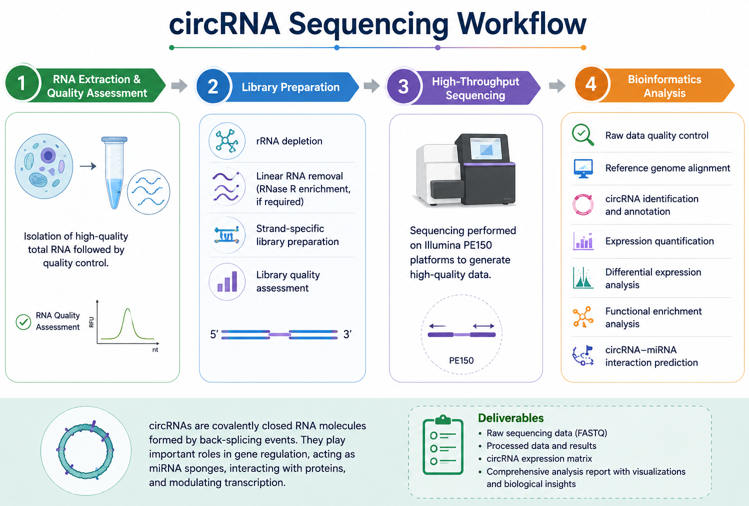
circRNA Sequencing Workflow
1. RNA Extraction & Quality Assessment
Isolation of high-quality total RNA followed by quality control.
2. Library Preparation
• rRNA depletion
• Linear RNA removal (RNase R enrichment, if required)
• Strand-specific library preparation
• Library quality assessment
3. High-Throughput Sequencing
Sequencing performed on Illumina PE150 platforms to generate high-quality data.
DNA-free RNA stored in nuclease-free water or RNA stabilization solution
Sample requirements may vary depending on the project. Please contact our team for customized recommendations.
Sequencing Specifications
• Library type: Strand-specific RNA library
• Sequencing platform: Illumina PE150
• High-quality sequencing data with stringent quality control
Bioinformatics Deliverables
Our standard analysis package includes:
• Raw sequencing data (FASTQ)
• Quality control reports
• Read alignment
• circRNA identification and annotation
• Known and novel circRNA expression profiling
• Differential expression analysis
• GO and pathway enrichment analysis
• circRNA–miRNA interaction network prediction
• Comprehensive bioinformatics report
Why Choose N2Jenomics Lab?
Our optimized circRNA sequencing workflow combines rigorous quality control, advanced sequencing technologies, and expert bioinformatics to deliver high-confidence circRNA profiles. Whether your research focuses on cancer biology, biomarker discovery, functional genomics, or RNA regulation, our team provides reliable data and comprehensive analytical support tailored to your research objectives.
1. How are circRNAs generated?
circRNAs are produced through a process called back-splicing, where downstream splice donor sites join upstream splice acceptor sites to form a covalently closed circular RNA molecule. This unique structure lacks 5' and 3' ends, making circRNAs highly stable and resistant to exonuclease-mediated degradation.
2. Why is high-throughput sequencing preferred over microarrays for circRNA analysis?
High-throughput RNA sequencing offers several advantages over microarrays:
• Detection of novel circRNAs: Identifies both known and previously uncharacterized circRNAs without requiring predefined probes.
• Wider dynamic range: Accurately quantifies transcripts across a broad range of expression levels.
• Higher sensitivity and specificity: Improves detection of low-abundance circRNAs and differential expression.
• Comprehensive transcriptome profiling: Simultaneously analyzes circRNAs alongside other RNA species and supports discovery of sequence variants and novel splice junctions.
3. Can circRNA sequencing identify novel circRNAs?
Yes. Unlike probe-based technologies, circRNA sequencing can detect both known and novel circRNAs by identifying unique back-splice junctions. This makes it a powerful approach for transcriptome-wide circRNA discovery and biomarker research.
4. What are the common applications of circRNA sequencing?
circRNA sequencing is widely used for:
• Cancer and disease mechanism research
• Biomarker discovery
• Gene regulation studies
• circRNA–miRNA interaction analysis
• Functional genomics
• Developmental biology and precision medicine research
Address:Registered Office: 138, Patparganj Industrial Area, New Delhi – 110092, India
Operational Address: National Institute of Plant Genome Research (BRIC - NGGF)
Lab No. 206 and 207, Aruna Asaf Ali Marg, P.O. Box No. 10531,
New Delhi – 110067, India