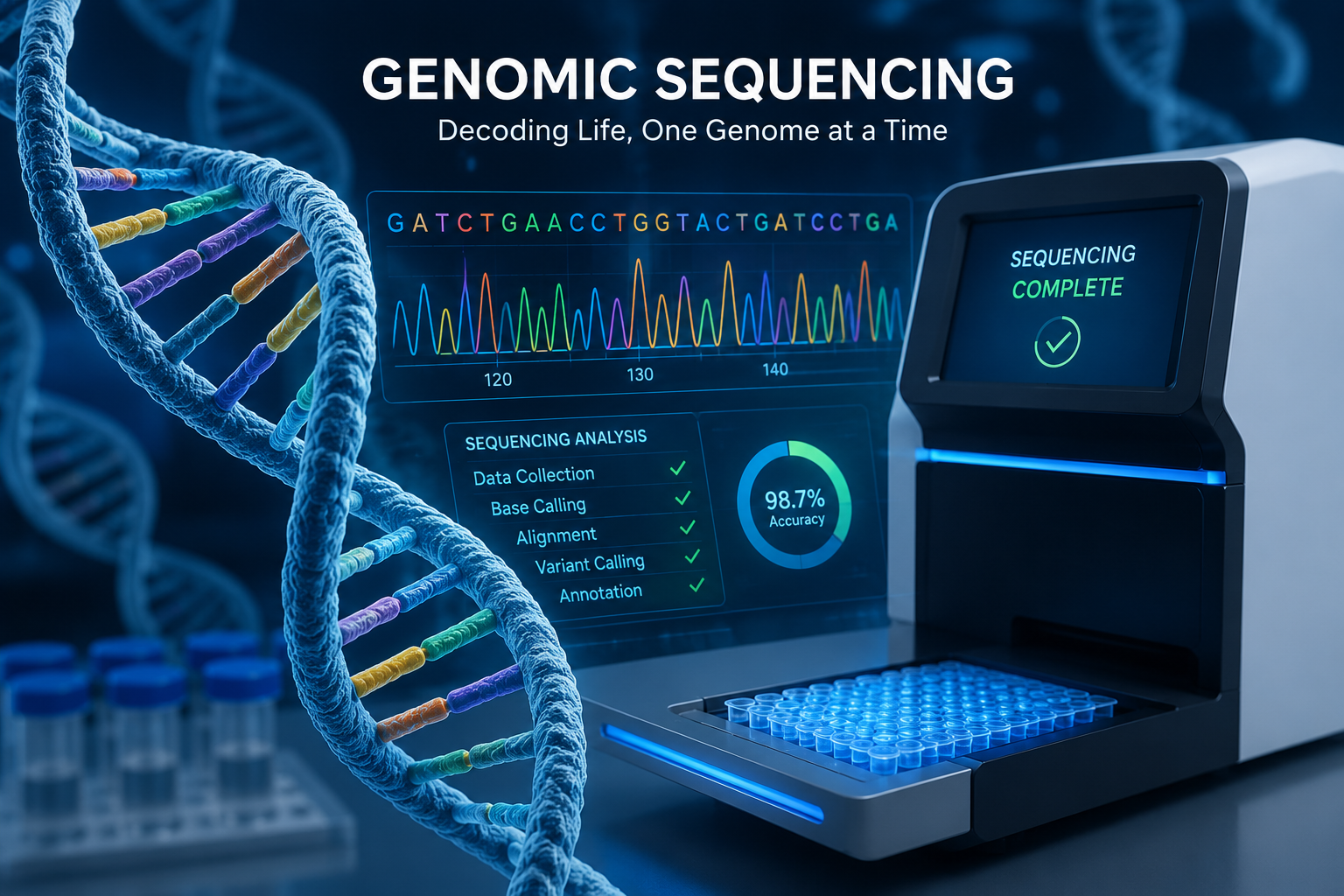
What is Genomic DNA Sequencing?
Genomic DNA sequencing is an advanced molecular technology used to determine the complete DNA sequence of an organism's genome. By decoding the genetic information contained within DNA, researchers gain valuable insights into gene structure, genetic variation, and biological function.
This technology has become an essential tool across life sciences, supporting studies in genetics, genomics, evolutionary biology, agriculture, biotechnology, and biomedical research. Comprehensive genome sequencing enables scientists to investigate the relationship between genetic variation and observable traits, understand the molecular basis of diseases, and explore evolutionary processes across diverse species.
Genomic DNA Sequencing Technologies
DNA sequencing has evolved significantly over the past several decades and is now broadly categorized into three major technology platforms, each offering unique advantages for different research applications.
1. First-Generation Sequencing (Sanger Sequencing)
Sanger sequencing is the pioneering DNA sequencing technology and remains widely recognized for its exceptional accuracy when analyzing targeted DNA fragments. The method relies on DNA polymerase-mediated strand synthesis together with chain-terminating nucleotides, allowing the precise determination of nucleotide order within a DNA molecule.
Although it is highly accurate, Sanger sequencing is generally best suited for small-scale sequencing projects, sequence verification, mutation confirmation, and targeted genetic analysis due to its relatively lower throughput.
2. Next-Generation Sequencing (NGS)
Next-Generation Sequencing (NGS), also known as High-Throughput Sequencing (HTS), has transformed genomic research by enabling the parallel sequencing of millions of DNA fragments in a single experiment.
Compared with conventional sequencing methods, NGS offers:
- • High sequencing throughput
- • Excellent accuracy and reproducibility
- • Rapid data generation
- • Cost-effective analysis for large-scale projects
- • Scalability for diverse research applications
Platforms such as Illumina sequencing have become the standard for whole genome sequencing, targeted sequencing, exome sequencing, transcriptomics, metagenomics, and population genomics. While NGS typically produces shorter sequencing reads, advanced bioinformatics pipelines enable efficient genome assembly, variant detection, and downstream genomic analysis.
3. Third-Generation Sequencing (Long-Read Sequencing)
Third-generation sequencing technologies analyze individual DNA molecules without requiring PCR amplification, enabling the generation of substantially longer sequencing reads. Long-read platforms, including PacBio Single Molecule Real-Time (SMRT) Sequencing and Oxford Nanopore Sequencing, are particularly valuable for resolving complex genomic regions that are difficult to assemble using short-read data alone.
Long-read sequencing is especially useful for:
- • High-quality de novo genome assembly
- • Structural variant detection
- • Repeat region characterization
- • Haplotype phasing
- • Full-length transcript sequencing
- • Large and complex genome analysis
Applications of Genomic DNA Sequencing
Modern genomic DNA sequencing supports a broad range of scientific and clinical applications, including:
- • Whole genome sequencing
- • Comparative genomics
- • Population genetics
- • Evolutionary biology research
- • Disease-associated gene discovery
- • Precision medicine and clinical research
- • Agricultural genomics and crop improvement
- • Animal breeding and livestock genomics
- • Microbial genomics
- • Biodiversity and conservation studies
- • Forensic genetics
- • Biotechnology and pharmaceutical research
Overview of Next-Generation Sequencing (NGS) Technologies
Next-Generation Sequencing (NGS) has transformed genomic research by enabling rapid, high-throughput analysis of DNA and RNA. Modern sequencing platforms offer a range of capabilities, allowing researchers to select the most suitable technology based on project objectives, genome complexity, read length requirements, and analytical goals. Continuous advancements in sequencing chemistry and instrumentation have significantly improved data quality, throughput, and cost efficiency across a wide variety of research and clinical applications.
Single-Molecule Sequencing (Long-Read Sequencing)
Single-molecule sequencing, commonly referred to as long-read sequencing, has become an important advancement in genomics due to its ability to generate substantially longer sequencing reads compared to conventional short-read technologies. These longer reads enable more accurate assembly of complex genomes, improved detection of structural variants, and better resolution of repetitive genomic regions.
The two most widely adopted long-read sequencing technologies are:
-
- • Single Molecule Real-Time (SMRT) Sequencing developed by PacBio, which delivers highly accurate long reads suitable for genome assembly, full-length transcript sequencing, and structural variant analysis.
-
- • Nanopore Sequencing, developed by Oxford Nanopore Technologies, which sequences individual DNA or RNA molecules as they pass through nanopores, enabling real-time analysis, ultra-long reads, and portable sequencing capabilities.
These technologies have expanded the possibilities of genomic research and are widely used in applications such as de novo genome assembly, comparative genomics, microbial genomics, plant and animal genomics, metagenomics, transcriptomics, and precision medicine.