DNA methylation is one of the most important epigenetic modifications in the human genome. It primarily occurs at cytosine residues within CpG sites, where it regulates gene expression and helps maintain chromatin stability. This essential biological process plays a key role in embryonic development, cellular differentiation, aging, and other physiological functions.
Abnormal DNA methylation patterns are closely associated with a wide range of diseases. Aberrant methylation can silence tumor suppressor genes, contributing to cancer development, and has also been implicated in autoimmune disorders such as multiple sclerosis and diabetes. Unlike conventional genomics or transcriptomics, DNA methylation analysis provides unique insights into epigenetic regulation, enabling researchers to better understand disease mechanisms, aging, neurological disorders, and developmental biology.
While next-generation sequencing-based methylation analysis has advanced significantly, methylation microarrays remain the preferred platform for many large-scale studies due to their exceptional reproducibility, cost-effectiveness, ease of use, and extensive validation. With more than three million samples analyzed worldwide and hundreds of thousands of publicly available datasets, methylation array technology continues to serve as the foundation for epigenetic research.
At N2Jenomics Lab Pvt. Ltd., we offer comprehensive DNA methylation array services using the latest Illumina Methylation Screening Array (MSA 270K). This advanced platform provides researchers with an affordable, reliable, and high-throughput solution for large-scale epigenetic studies, enabling accurate methylation profiling across diverse research applications.
Introduction to the Illumina Methylation Screening Array (MSA 270K)
The Illumina Infinium Methylation Screening Array (MSA 270K) is a next-generation methylation microarray specifically designed for large population studies, disease cohort investigations, and health screening applications. While whole-genome bisulfite sequencing offers comprehensive methylation analysis, achieving comparable accuracy requires very deep sequencing coverage, making it significantly more resource-intensive for large studies.
Built upon the proven Infinium methylation platform, the MSA 270K leverages years of validated epigenetic research and extensive public reference datasets. It enables researchers to generate highly reproducible methylation profiles while substantially reducing experimental costs and turnaround times.
The array interrogates approximately 270,000 carefully selected CpG methylation sites across the human genome, focusing on biologically relevant regions associated with:
• Human traits and population diversity
• Disease susceptibility and phenotype
• Environmental exposure studies
• Aging and longevity research
• Epigenome-wide association studies (EWAS)
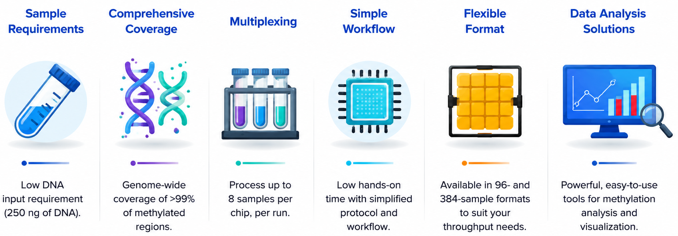
• Designed for high-throughput workflows, the MSA 270K supports the simultaneous processing of 48 samples per array, representing approximately a six-fold increase in sample throughput compared with earlier Infinium MethylationEPIC platforms. This enhanced capacity significantly lowers the cost per sample while maintaining the high accuracy, reproducibility, and data quality expected from Illumina's Infinium technology.
The combination of robust performance, scalable throughput, and cost efficiency makes the Illumina MSA 270K an ideal solution for biomarker discovery, clinical research, population-scale studies, and precision medicine initiatives.
Comparison of methylation assay 270K vs 935K
Feature
270K Array
935K Array
Primary Applications
Common Disease Research
Cancer Research
Environmental Epidemiology
Environmental Epidemiology
Population Genomics
Population Genomics
Consumer Genomics
Consumer Genomics
Rare Disease Research
Rare Disease Research
Research Focus
Established genetic associations with common diseases
Comprehensive cancer genomics and epigenomics profiling
Key Highlights
Environmental exposure-associated markers
Cell-type specific methylation profiling
High-confidence disease-associated variants
Intermediate methylation detection
High MAF multifunctional SNP analysis
Genome-wide single nucleotide polymorphism (SNP) profiling
Standard methylation analysis
Advanced methylation and biomarker discovery
Coverage
Genome-wide methylation analysis
>99% whole methylome coverage
RefSeq gene coverage
Comprehensive MGMT gene coverage
Standard gene annotation
Extensive RefSeq gene coverage
—
Compatible with published cancer classifiers
—
Copy Number Variation (CNV) detection
—
Compatible with published rare disease classifiers
—
Comprehensive coverage of cancer-driving mutations
CpG / Probe Count
269,094 Sites
930,301 Sites
Sample Throughput
48 Samples per Chip
8 Samples per Chip
DNA Input Requirement
50 ng
250 ng
Trait-Associated Loci in the Infinium Methylation Screening Array (MSA 270K)
The Illumina Infinium Methylation Screening Array (MSA 270K) features a comprehensive collection of rigorously curated and validated methylation loci associated with human traits and disease phenotypes. The array has been designed using extensive scientific evidence to support robust epigenetic studies across diverse research areas.
MSA 270K includes CpG sites linked to a broad spectrum of biological traits and disease categories, including:
• Cardiovascular diseases
• Metabolic disorders
• Mental and neurological health
• Autoimmune diseases
• Respiratory disorders
• Reproductive health
• Kidney and renal diseases
• Aging and longevity
• Genetic and inherited conditions
• Environmental exposure and toxicology
• Infectious diseases
This broad coverage enables researchers to investigate epigenetic alterations across multiple biological systems, facilitating biomarker discovery, disease risk assessment, population health studies, and epigenome-wide association studies (EWAS). The array provides a reliable, high-throughput platform for identifying methylation signatures associated with complex traits and human diseases.
Comprehensive and Expanded CpG Coverage
Approximately 50% of the CpG loci associated with known biological traits and diseases are represented on the array. These markers have been curated through extensive evaluation of published research, peer-reviewed scientific literature, and Infinium methylation array datasets, enabling robust investigation of DNA methylation patterns linked to diverse biological processes and disease phenotypes.
Enhanced Discovery of Novel Methylation Sites
The array includes approximately 100,000 additional CpG sites identified through large-scale whole-genome bisulfite sequencing (WGBS) studies. These newly incorporated loci are predominantly located within regulatory genomic regions and cell-type-specific chromatin states, expanding coverage of biologically relevant methylation sites identified from both bulk and single-cell methylome datasets.
Designed for Integrated Multi-Omics Research
In addition to comprehensive CpG methylation profiling, the array supports broader multi-omics investigations by incorporating 2,776 CpH methylation sites and 3,848 high-frequency single nucleotide polymorphism (SNP) markers selected from established genomic databases. This expanded content enables simultaneous exploration of epigenetic variation, genetic diversity, and their combined influence on gene regulation and complex biological traits.
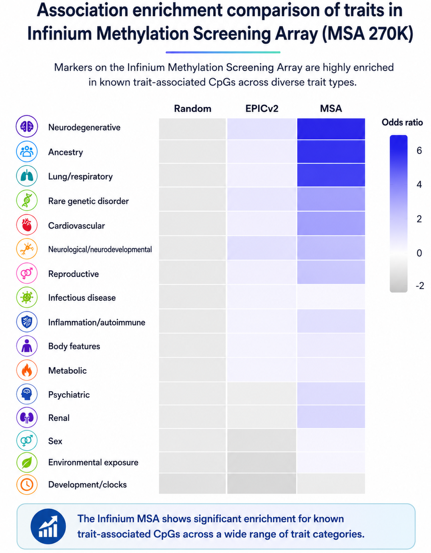
Association enrichment comparison of traits in Infinium Methylation Screening Array (MSA 270K)
The MSA 270K Methylation array, leveraging cutting-edge Infinium array chemistry, implements multiple bead-based retests for each CpG site. Each bead carries thousands of probes to ensure the accuracy and reliability of the detection results. After stringent internal testing, the reproducibility of the MSA 270K exceeds 98%, while its overlapping probes with the Infinium Methylation EPIC v2.0 (935K) exhibit reproducibility of over 96%, demonstrating exceptional performance and stability.
Advantages of the Illumina Methylation Screening Array (MSA 270K)
• Targeted Epigenetic Coverage
The MSA 270K interrogates approximately 270,000 carefully selected CpG methylation sites associated with human traits, disease phenotypes, environmental exposures, aging, and other biologically relevant processes. This focused design enables comprehensive and efficient analysis of disease-related epigenetic variation.
• High-Throughput Scalability
Designed for large-scale studies, the array supports 48 samples per BeadChip and can process up to 600,000 samples annually on a single Illumina iScan™ System, making it an ideal solution for population-based and cohort studies.
• Highly Reproducible and Reliable Results
The platform delivers greater than 98% sample-to-sample reproducibility, providing consistent, accurate, and high-quality methylation data for robust downstream analysis and confident biological interpretation.
• Scientifically Curated Content
The array content has been developed through extensive expert curation, integrating evidence from published epigenome-wide association studies (EWAS), functional genomics research, whole-genome sequencing, and leading genomic databases. This comprehensive approach ensures broad coverage of validated and predicted epigenetic biomarkers.
• Comprehensive Multi-Omics Insights
In addition to CpG methylation analysis, the MSA 270K includes non-CpG methylation sites and high-frequency single nucleotide polymorphisms (SNPs), enabling integrated genetic and epigenetic analyses for deeper insights into disease biology across diverse populations.
• Enhanced Genomic Content
The array incorporates novel markers identified through whole-genome bisulfite sequencing (WGBS) datasets, covering genomic regions associated with cell type specificity, gene regulation, chromatin accessibility, and other important functional genomic features. This expanded content improves the ability to uncover biologically meaningful epigenetic signatures.
• Optimized Workflow for Large Studies
Built on the Illumina Infinium EX Methylation platform, the MSA 270K delivers a streamlined workflow with improved throughput, reduced processing time, and lower cost per sample. These advantages make it well suited for high-volume research, clinical studies, and large-scale population screening projects.
• Simplified Quality Control and Data Analysis
The platform is supported by Illumina's robust software ecosystem for automated quality control, data processing, and methylation analysis, enabling researchers to generate reliable, reproducible, and publication-ready results with confidence.
Workflow of Methylation Screening Array Analysis
Bioinformatics analysis
Analysis
Description
Standard Deliverables
Comprehensive raw data and annotation files provided for downstream analysis.
Files Included:
• Sample Annotation Files
• Variable Annotation Files
• Scanner Output (IDAT Files)
Differential Methylation Analysis (DMA)
Identify significant differences in DNA methylation patterns between experimental groups to uncover biologically relevant epigenetic changes.
Files Included:
• Comprehensive analysis report with summary and publication-quality visualizations
• Differentially Methylated CpGs (DMCs) with genomic region classification (CpG Islands, Shores, Shelves, and Open Sea)
• Differentially Methylated Regions (DMRs) highlighting significant regional methylation changes
Gene Ontology (GO) Enrichment Analysis
Functional enrichment analysis to identify significantly associated biological processes, molecular functions, and cellular components affected by differential methylation.
Pathway Enrichment Analysis
Discover significantly enriched biological pathways and molecular networks associated with differentially methylated genes, providing insights into the underlying biological mechanisms and disease pathways.
Delivery
• Raw Data • Probe Report • Peaks Report • Summary Report
Operational Address: National Institute of Plant Genome Research (BRIC - NGGF)
Lab No. 206 and 207, Aruna Asaf Ali Marg, P.O. Box No. 10531,
New Delhi – 110067, India