Single-Cell Sequencing
Home
>
Sequencing
> Single-Cell Sequencing
Uncover Cellular Diversity with High-Resolution Single-Cell Genomics
Single-cell sequencing is a transformative technology that enables comprehensive molecular profiling at the level of individual cells. Unlike conventional bulk sequencing, which measures the average signal across a mixed cell population, single-cell sequencing reveals the unique genomic, transcriptomic, epigenomic, and proteomic characteristics of each cell. This unprecedented resolution allows researchers to investigate cellular heterogeneity, identify rare cell populations, and gain deeper insights into complex biological systems.
At N2Jenomics Lab Pvt. Ltd., we offer end-to-end Single-Cell Sequencing Services powered by industry-leading platforms such as 10x Genomics Chromium, combined with advanced bioinformatics to help researchers uncover novel biological mechanisms across cancer, immunology, neuroscience, developmental biology, and precision medicine.
Why Choose Single-Cell Sequencing?
Traditional sequencing methods analyze RNA or DNA extracted from a mixture of cells, providing an average molecular profile for the entire sample. While this approach is valuable for many studies, it cannot distinguish differences between individual cell types or detect rare cellular populations.
Single-cell sequencing overcomes these limitations by analyzing each cell independently, allowing researchers to:
• Characterize cellular heterogeneity.
• Identify rare or previously unknown cell populations.
• Explore cell-to-cell variation in gene expression.
• Study cellular differentiation and lineage relationships.
• Understand complex tissue organization.
• Investigate disease progression at single-cell resolution.
This high-resolution approach provides a more accurate understanding of biological processes than conventional bulk sequencing.
Why Perform Single-Cell RNA Sequencing?
Single-cell RNA sequencing (scRNA-seq) has become one of the most powerful tools for studying gene expression dynamics in complex tissues.
For example, while bulk RNA sequencing can identify genes that are differentially expressed between healthy and diseased tissues, it cannot determine which individual cell types contribute to these differences.
By analyzing gene expression at the single-cell level, researchers can:
• Investigate tumor heterogeneity.
• Identify distinct cancer cell populations.
• Study clonal evolution during disease progression.
• Characterize the tumor microenvironment.
• Explore mechanisms of metastasis.
• Understand therapeutic response and drug resistance.
• Discover novel biomarkers and therapeutic targets.
• These capabilities make scRNA-seq an essential technology for modern biomedical research.
Single-Cell Sequencing Technologies
Several technologies have been developed to isolate and analyze individual cells. Modern workflows combine efficient single-cell capture with molecular barcoding and high-throughput sequencing.
Microplate-Based Single-Cell Sequencing
This approach distributes individual cells into separate wells of a microplate, where each cell is independently lysed and processed for library preparation.
Advantages include:
• High sample control.
• Suitable for targeted studies.
• Accurate cell isolation.
• Flexible experimental design.
Representative platforms include BD Rhapsody and Singleron technologies.
Microdroplet-Based Single-Cell Sequencing
Microfluidic systems encapsulate individual cells together with uniquely barcoded beads inside microscopic droplets. Following cell lysis, nucleic acids are labeled with cell-specific barcodes, allowing thousands of cells to be processed simultaneously.
Benefits include:
• Extremely high throughput.
• Efficient molecular barcoding.
• Scalable library preparation.
• Cost-effective large-scale experiments.
This strategy is widely adopted by platforms such as Drop-seq, inDrop, and 10x Genomics Chromium.
10x Genomics Single-Cell Solutions
The 10x Genomics Chromium platform has become the industry standard for high-throughput single-cell analysis, supporting a broad range of applications beyond transcriptomics.
• CITE-seq for simultaneous RNA and surface protein profiling.
These technologies enable comprehensive multi-dimensional characterization of individual cells.
Our Single-Cell Sequencing Services
At N2Jenomics Lab Pvt. Ltd., we provide comprehensive single-cell sequencing solutions supported by advanced laboratory workflows and expert bioinformatics.
Our services include:
• Single-Cell RNA Sequencing (scRNA-seq)
Characterize gene expression profiles of individual cells to identify cell populations, investigate cellular heterogeneity, and study biological pathways.
• Single-Cell DNA Sequencing
Detect genomic alterations, copy number variations, and somatic mutations at single-cell resolution.
• Single-Cell DNA Methylation Sequencing
Investigate epigenetic regulation, DNA methylation patterns, and cellular epigenetic heterogeneity.
• 10x Genomics Single-Cell Sequencing
Comprehensive Chromium-based workflows for transcriptomics, immune profiling, chromatin accessibility, and multi-omics applications.
Advantages of Our Single-Cell Sequencing Services
• End-to-End Workflow
Comprehensive support from experimental design and sample preparation through sequencing, bioinformatics, and biological interpretation.
• High-Throughput Processing
Efficient processing of thousands to tens of thousands of individual cells in a single experiment for comprehensive cellular profiling.
• Advanced Sequencing Platforms
State-of-the-art technologies, including 10x Genomics Chromium, deliver highly reproducible and reliable single-cell datasets.
• Comprehensive Bioinformatics
Specialized analysis pipelines provide:
- Cell clustering.
- Cell type annotation.
- Differential gene expression analysis.
- Trajectory and pseudotime analysis.
- Cell-cell interaction analysis.
- Pathway enrichment.
- Multi-omics data integration.
• Customized Project Design
Flexible workflows tailored to diverse research objectives, sample types, species, and experimental designs.
• Expert Scientific Support
Our experienced genomics and bioinformatics specialists provide technical guidance throughout every stage of your project.
Applications of Single-Cell Sequencing
Single-cell sequencing has become an indispensable tool across multiple areas of life science research.
• Cancer Research
- Tumor heterogeneity analysis.
- Clonal evolution studies.
- Tumor microenvironment characterization.
- Drug resistance mechanisms.
- Biomarker discovery.
• Clinical Research
- Analysis of limited clinical specimens.
- Precision medicine research.
- Disease biomarker identification.
- Patient stratification.
• Immunology
- Immune cell profiling.
- Immune repertoire characterization.
- Inflammation research.
- Vaccine response studies.
• Developmental Biology
- Cell lineage tracing.
- Embryonic development.
- Stem cell differentiation.
- Tissue development.
• Neuroscience
- Brain cell atlas construction.
- Neural development.
- Neurodegenerative disease research.
- Cellular diversity of the nervous system.
• Microbiology
- Microbial community profiling.
- Host-microbe interactions.
- Environmental microbiology.
- Microbial ecology studies.
Reproductive & Genetic Medicine
- Preimplantation genetic studies.
- Reproductive biology research.
- Developmental genetics.
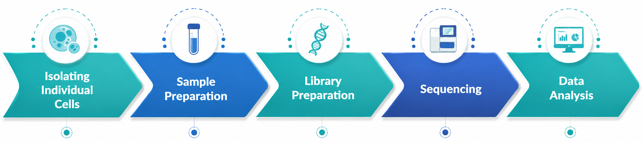
Single-Cell Sequencing Workflow
Every project follows a carefully optimized workflow designed to maximize data quality and biological insight.
Step 1: Sample Preparation
• Tissue dissociation or cell isolation.
• Single-cell suspension preparation.
• Cell viability assessment.
• Quality control.
Step 2: Single-Cell Capture
• Microfluidic or microplate-based cell isolation.
• Individual cell encapsulation.
• Cell barcoding.
• Molecular indexing.
Step 3: Library Preparation
• Cell lysis.
• Reverse transcription (for RNA applications).
• Amplification.
• Sequencing library construction.
• Library quality assessment.
Step 4: Next-Generation Sequencing
• High-throughput sequencing using advanced NGS platforms.
• Generation of high-quality single-cell sequencing data.
• Publication-ready visualizations and comprehensive reports.
Sample Requirements
Below are the sample requirements for some of our single-cell sequencing services. For more detailed information, please refer to the specific service pages or Sample Submission Guidelines. Additionally, if you are interested in our services, please contact us to confirm the sequencing sample requirements.
Service
Sample Type
Recommended Quantity
Minimum Quantity
ScRNA-seq
Single cell suspension, Fresh tissue
2×10⁶ cells
1×10⁶ cells
10X Visium Spatial Transcriptome
OCT embedded tissue, FFPE
6.5mm×6.5mm
Single Cell Genome Sequencing
Cells DNA
1-103, Single cells are stored in 1xPBS buffer (without Ca2+, Mg2+), the volume is within 2 μL ≥ 0.5pg
Use 200µl PCR tubes to store cells (single or multiple cells), 5µl of lysate per tube, and no more than 1µl of buffer when collecting cells. ≥3 biological replicates
Use 200µl PCR tubes to store cells (single or multiple cells), 5µl of lysate per tube, and no more than 1µl of buffer when collecting cells. ≥3 biological replicates
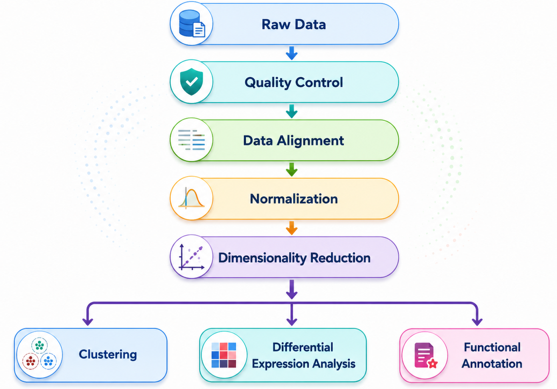
Analysis Pipeline
Deliverables
• The original sequencing data
• Experimental results
• Data analysis report
• Details in Single-Cell Sequencing for your writing (customization)
Multiple Displacement Amplification (MDA)
Multiple Displacement Amplification (MDA) is an isothermal whole genome amplification technique that employs random hexamer primers together with Phi29 DNA polymerase. Owing to its powerful strand displacement capability and 3′→5′ proofreading activity, Phi29 polymerase generates long DNA fragments with exceptional accuracy and broad genome coverage.
MDA is particularly well suited for applications that require highly accurate genome amplification and reliable variant detection.
Key Features
• Isothermal whole genome amplification.
• Utilizes high-fidelity Phi29 DNA polymerase.
• Generates long DNA fragments with extensive genome coverage.
• Produces high-quality amplified DNA suitable for downstream sequencing.
Advantages
• Excellent genome coverage.
• High amplification fidelity due to proofreading activity.
• Long amplification products for comprehensive genome analysis.
• Ideal for detecting single nucleotide variants (SNVs) and other sequence-level mutations.
Limitations
• Amplification bias may occur in certain genomic regions.
• Coverage uniformity can vary across the genome.
• Less optimal for highly quantitative copy number variation (CNV) studies compared with uniform amplification methods.
Multiple Annealing and Looping-Based Amplification Cycles (MALBAC)
MALBAC is a quasi-linear whole genome amplification method developed to improve amplification uniformity across the genome. During the initial amplification cycles, specially designed primers generate looped amplicons that minimize repeated amplification of the same DNA fragments, reducing amplification bias.
This strategy provides highly reproducible genome representation across individual cells, making MALBAC particularly valuable for quantitative genomic analyses.
Key Features
• Quasi-linear amplification strategy.
• Reduced amplification bias.
• Highly reproducible genome coverage.
• Improved consistency between single-cell samples.
Advantages
• Excellent amplification uniformity.
• High reproducibility across different cells.
• Well suited for copy number variation (CNV) analysis.
• Reliable quantitative genome profiling.
Limitations
• Lower polymerase fidelity than Phi29-based MDA.
• Increased likelihood of false-positive SNV detection.
• Certain low-amplification genomic regions may remain underrepresented.
Comparison of MDA and MALBAC
Feature
MDA
MALBAC
Amplification Strategy
Isothermal whole genome amplification
Quasi-linear whole genome amplification
Polymerase Fidelity
Very high
High
Genome Coverage
Excellent
Excellent
Amplification Uniformity
Moderate
Excellent
SNV Detection
Highly suitable
Suitable, with relatively higher false-positive rates
Operational Address: National Institute of Plant Genome Research (BRIC - NGGF)
Lab No. 206 and 207, Aruna Asaf Ali Marg, P.O. Box No. 10531,
New Delhi – 110067, India