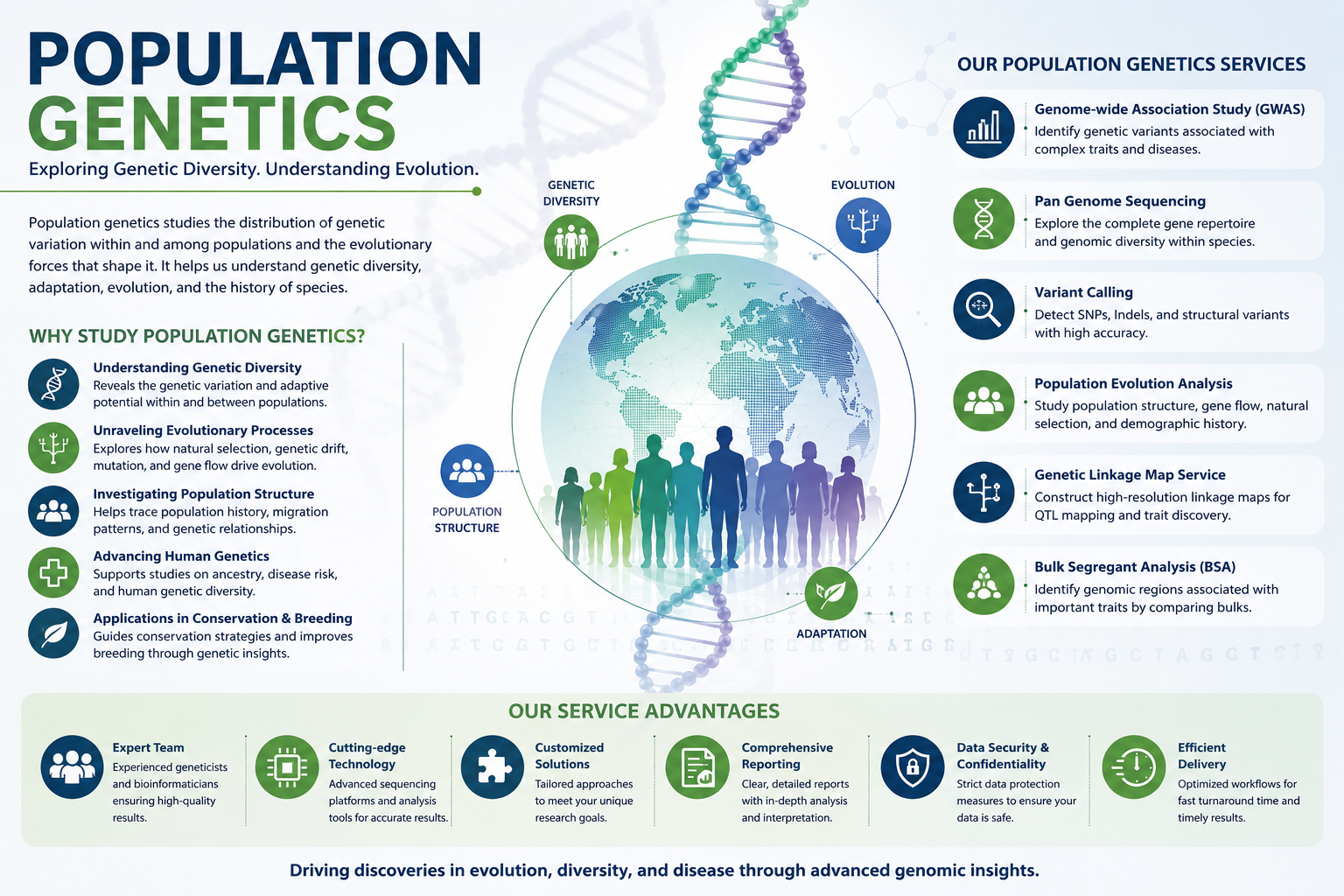
What is Population Genetics?
Population genetics is the branch of genetics that explores how genetic variation is distributed and inherited within and among populations of a species. It examines the changes in allele frequencies over time and investigates the evolutionary forces—such as natural selection, genetic drift, mutation, gene flow, and recombination—that shape genetic diversity.
By studying genetic variation across populations, researchers gain valuable insights into evolutionary history, population structure, adaptation, migration patterns, and species diversity. As a cornerstone of evolutionary biology and ecology, population genetics plays a critical role in understanding how species evolve, adapt to changing environments, and maintain biodiversity.
Why Study Population Genetics?
Population genetics provides a deeper understanding of how genetic diversity is created, maintained, and influenced by evolutionary and environmental factors. It enables scientists to uncover the mechanisms driving biological diversity and offers valuable applications across medicine, agriculture, conservation, and evolutionary research.
• Understanding Genetic Diversity
Population genetics helps researchers measure and analyze the genetic diversity present within populations. Studying this variation provides insights into a species' adaptability, resilience, and evolutionary potential. It also reveals how populations respond to environmental changes, disease pressures, and other selective forces.
• Understanding Evolutionary Processes
One of the primary objectives of population genetics is to investigate the evolutionary mechanisms that influence genetic variation. These include natural selection, genetic drift, mutation, and gene flow. By examining how allele frequencies change across generations, scientists can better understand the evolutionary history and adaptive processes of populations.
• Investigating Population Structure and Divergence
Population genetics enables researchers to evaluate the genetic relationships between populations and determine the extent of their divergence. These studies help reconstruct migration routes, identify patterns of gene flow, trace ancestral origins, and reveal the historical distribution of species. Such insights are essential for conservation biology, wildlife management, and evolutionary studies.
• Advancing Human Genetics Research
In human genetics, population genetics is instrumental in exploring genetic diversity across different ethnic and geographical populations. It helps identify population-specific genetic variants, understand ancestry and demographic history, and investigate the genetic basis of inherited diseases. These findings contribute significantly to precision medicine, disease risk assessment, and the development of personalized healthcare strategies.
• Applications in Conservation and Breeding
Population genetics is widely applied in conservation biology to monitor endangered species, assess genetic health, and develop effective conservation strategies. It also supports plant and animal breeding programs by identifying beneficial genetic traits, improving breeding efficiency, and enhancing genetic diversity for sustainable agriculture.
How to Study Population Genetics
At N2Jenomics Lab Pvt. Ltd., we provide a comprehensive suite of advanced genomics and bioinformatics services designed to support population genetics research across diverse organisms. From identifying genetic variants and understanding population structure to investigating evolutionary relationships and trait-associated genes, our integrated solutions empower researchers with accurate, high-quality data and actionable insights.
Our experienced scientists combine state-of-the-art sequencing technologies with robust analytical pipelines to deliver reliable results tailored to your research objectives.
Our Population Genetics Services
• Genome-Wide Association Study (GWAS)
Genome-Wide Association Studies (GWAS) are widely used to identify genetic variants associated with complex traits and diseases. By analyzing genetic variation across large populations, GWAS helps uncover the relationship between specific genomic regions and observable phenotypes.
Our GWAS services include comprehensive study design, quality control, statistical association analysis, visualization, and biological interpretation, enabling researchers to identify meaningful genetic markers with confidence.
• Pan-Genome Sequencing
Pan-genome sequencing provides a comprehensive view of the complete genetic diversity within a species by identifying both core and variable genes across multiple individuals.
Our pan-genome sequencing services enable researchers to explore genomic diversity, evolutionary relationships, structural variations, and species-specific adaptations. We deliver high-quality sequencing data supported by comprehensive bioinformatics analysis for deeper biological insights.
• Variant Calling
Variant calling is a fundamental step in population genetics that identifies genetic differences among individuals, including Single Nucleotide Polymorphisms (SNPs), insertions/deletions (Indels), structural variants, and other genomic alterations.
Using advanced computational pipelines and stringent quality control measures, our variant calling services provide highly accurate variant detection, annotation, and interpretation to support downstream genetic analyses.
• Population Evolution Analysis
Population evolution analysis investigates how populations change over time under the influence of natural selection, mutation, migration, genetic drift, and environmental pressures.
Our services help researchers analyze population structure, gene flow, demographic history, phylogenetic relationships, and adaptive evolution, providing valuable insights into the evolutionary processes shaping genetic diversity.
• Genetic Linkage Mapping
Genetic linkage maps illustrate the relative positions of genes and genetic markers based on recombination frequencies. They are essential tools for identifying genes associated with important traits and understanding genome organization.
Our genetic linkage mapping services generate high-resolution linkage maps that support quantitative trait locus (QTL) mapping, marker-assisted breeding, comparative genomics, and genome assembly projects.
• Bulk Segregant Analysis (BSA)
Bulk Segregant Analysis (BSA) is a powerful approach for rapidly identifying genomic regions associated with specific traits by comparing pooled samples representing contrasting phenotypes.
Our BSA workflow combines next-generation sequencing with advanced bioinformatics analysis to efficiently identify candidate genes and genetic markers responsible for important agricultural, clinical, and biological traits.
• Genotyping-by-Sequencing (GBS)
Genotyping-by-Sequencing (GBS) is a cost-effective, high-throughput technique that simultaneously discovers and genotypes genetic variants across the genome.
GBS is widely used for genetic diversity studies, linkage mapping, genomic selection, association mapping, and breeding applications. Our optimized GBS pipelines provide accurate SNP discovery and genotyping for a wide range of species.
• Whole Genome Sequencing (WGS) & Resequencing
Whole Genome Sequencing (WGS) provides complete genomic information by sequencing an organism's entire DNA, while genome resequencing compares multiple individuals against a reference genome to identify genetic variations.
Our WGS and resequencing services enable comprehensive analysis of SNPs, Indels, structural variants, copy number variations (CNVs), and other genomic alterations, supporting evolutionary biology, disease research, and breeding programs.
• Reduced Representation Genome Sequencing (RRGS)
Reduced Representation Genome Sequencing (RRGS) focuses on sequencing selected portions of the genome, providing an efficient balance between sequencing depth and project cost.
This approach is ideal for large-scale population studies, SNP discovery, genetic diversity analysis, association studies, and evolutionary research where whole-genome sequencing may not be necessary.
• Target Region Sequencing
Target Region Sequencing enables focused analysis of selected genes or genomic regions using enrichment technologies such as hybridization capture or PCR amplification.
Our targeted sequencing solutions provide high-depth, accurate sequencing of regions associated with inherited disorders, disease biomarkers, candidate genes, and other areas of biological interest.
• SNP Microarray
SNP Microarray technology enables rapid, high-throughput genotyping of hundreds of thousands to millions of known Single Nucleotide Polymorphisms (SNPs) across the genome.
Our SNP microarray services support genome-wide association studies, population genetics, ancestry analysis, pharmacogenomics, disease susceptibility research, copy number variation (CNV) analysis, and precision medicine applications with reliable and reproducible results.
Why Choose N2Jenomics Lab Pvt. Ltd.?
• Comprehensive end-to-end population genetics solutions
• Expertise in human, plant, animal, and microbial genomics
• Advanced sequencing platforms and high-throughput technologies
• Robust bioinformatics pipelines with expert data interpretation
• Customized workflows tailored to specific research objectives
• High-quality data generation with stringent quality control
• Fast turnaround time with dedicated scientific support
Whether your research focuses on evolutionary biology, biodiversity, conservation genetics, crop improvement, animal breeding, or human genetics, N2Jenomics Lab Pvt. Ltd. provides the expertise and technology needed to transform complex genomic data into meaningful biological discoveries.
Service Advantages
At N2Jenomics Lab Pvt. Ltd., we are committed to delivering high-quality population genetics solutions that combine advanced genomics technologies with scientific expertise. Our services are designed to provide accurate, reliable, and actionable insights to support your research objectives.
• Expert Scientific Team
Our multidisciplinary team of geneticists, bioinformaticians, and genomics specialists brings extensive experience in population genetics research. With deep expertise in sequencing technologies, statistical genetics, and bioinformatics, we deliver accurate analyses and meaningful biological interpretations.
• Advanced Technologies
We leverage state-of-the-art sequencing platforms, high-throughput genotyping technologies, and robust bioinformatics pipelines to generate precise and reproducible results. Every project is supported by stringent quality control measures to ensure data accuracy and reliability.
• Customized Research Solutions
Every research project is unique. We work closely with researchers to develop customized workflows tailored to specific study designs, sample types, species, and scientific objectives, ensuring optimal outcomes for each project.
• Comprehensive Data Analysis & Reporting
Our detailed reports present complex genomic data in a clear, organized, and easy-to-understand format. Along with comprehensive statistical analyses and visualizations, we provide expert interpretation to help researchers draw meaningful biological conclusions and make informed scientific decisions.
• Data Security & Confidentiality
Protecting your research data is one of our highest priorities. We maintain strict data security protocols and confidentiality standards throughout every stage of the project, ensuring your valuable genomic data remains secure and protected.
• Fast Turnaround Time
Our streamlined workflows, optimized laboratory processes, and efficient bioinformatics pipelines enable us to deliver high-quality results within competitive turnaround times without compromising accuracy or quality.
• Dedicated Scientific Support
From project planning and experimental design to data analysis and result interpretation, our scientific team provides continuous technical support throughout your research journey, ensuring a seamless and productive collaboration.