Epigenomics is an emerging branch of genomics that explores heritable changes in gene activity that occur without altering the underlying DNA sequence. These changes, mediated through DNA methylation, histone modifications, chromatin remodeling, and non-coding RNAs, play critical roles in gene regulation, development, cellular differentiation, and disease progression.
With the rapid advancement of next-generation sequencing (NGS) technologies, epigenomic studies generate massive datasets that require sophisticated computational analysis to uncover biologically meaningful insights. Successful epigenomic research depends on the careful integration of experimental design and bioinformatics analysis, ensuring that subtle but biologically significant epigenetic changes are accurately identified and interpreted.
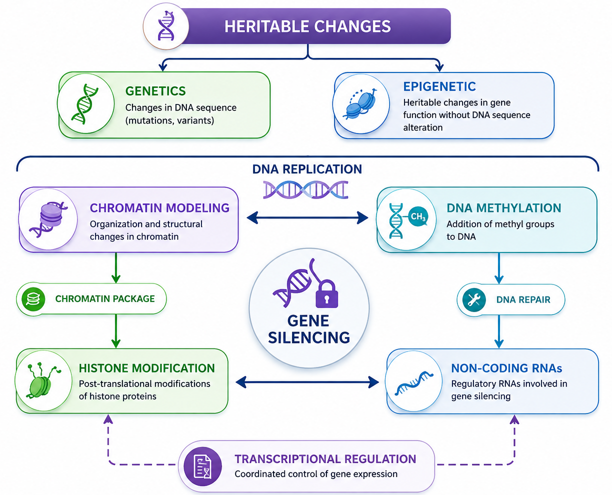
Bioinformatics Analysis of Epigenetics: Decoding the Language of the Epigenome
Bioinformatics forms the backbone of modern epigenomics research by transforming raw sequencing data into actionable biological knowledge. Advanced computational pipelines enable researchers to identify epigenetic modifications, characterize chromatin architecture, discover regulatory elements, and investigate gene expression regulation across diverse biological systems.
Modern epigenomic analysis combines statistical modeling, machine learning, and integrative multi-omics approaches to reveal complex regulatory mechanisms associated with normal development, environmental responses, and diseases such as cancer, neurological disorders, autoimmune diseases, and metabolic syndromes.
Computational analysis supports every stage of epigenomic research, including:
• Quality assessment and preprocessing of sequencing data
- • Alignment to reference genomes
- • Peak detection and annotation
- • DNA methylation analysis
- • Differential epigenetic analysis
- • Chromatin accessibility profiling
- • Regulatory network discovery
- • Functional enrichment analysis
- • Multi-omics data integration
- • Visualization and biological interpretation
These analyses provide comprehensive insights into the genomic distribution of epigenetic marks and help identify novel biomarkers, regulatory pathways, and therapeutic targets.
Our Epigenomics Data Analysis Services
At N2Jenomics Lab Pvt. Ltd., we provide comprehensive bioinformatics solutions for epigenomics research, enabling scientists to decode complex epigenetic regulatory mechanisms with confidence.
Our team of experienced bioinformaticians develops and continuously optimizes robust analytical pipelines using state-of-the-art computational tools, statistical frameworks, and machine learning approaches. We deliver accurate, reproducible, and publication-ready results with rapid turnaround times.
Our services include:
- • Chromatin accessibility analysis (ATAC-Seq)
- • Chromatin immunoprecipitation sequencing (ChIP-Seq)
- • Whole Genome Bisulfite Sequencing (WGBS)
- • Reduced Representation Bisulfite Sequencing (RRBS)
- • Targeted Bisulfite Sequencing (TBS)
- • Illumina EPIC Methylation Array analysis
- • MeDIP-Seq analysis
- • RNA-Seq integration
- • Peak calling and genomic annotation
- • Differential peak analysis
- • Differential methylation analysis
- • Motif discovery and transcription factor binding site analysis
- • Chromatin state characterization
- • Functional enrichment and pathway analysis
- • Integrative multi-omics analysis
- • Machine learning-based biomarker discovery
- • Publication-quality visualization and reporting
Epigenomic Assays: Unveiling the Epigenetic Landscape
Epigenomic assays enable comprehensive characterization of chromatin organization, DNA methylation, histone modifications, and transcriptional regulation. We offer end-to-end bioinformatics support for a broad range of epigenomic sequencing technologies.
- ChIP-Seq (Chromatin Immunoprecipitation Sequencing)
ChIP-Seq identifies genome-wide DNA binding sites of transcription factors, histone modifications, and chromatin-associated proteins. Our comprehensive analysis pipeline includes:
- • Raw data quality assessment
- • Read alignment and filtering
- • Peak calling
- • Peak annotation
- • Motif enrichment analysis
- • Differential binding analysis
- • Functional enrichment
- • Visualization using genome browsers
- • Publication-ready figures and reports
These analyses help uncover regulatory elements, transcription factor networks, and chromatin modifications governing gene expression.
- ATAC-Seq (Assay for Transposase-Accessible Chromatin Sequencing)
ATAC-Seq provides high-resolution maps of open chromatin regions, enabling researchers to investigate regulatory DNA elements and chromatin accessibility.
Our ATAC-Seq analysis includes:
- • Quality control and preprocessing
- • Genome alignment
- • Accessible chromatin peak identification
- • Differential accessibility analysis
- • Motif discovery
- • Transcription factor footprinting
- • Gene annotation
- • Functional enrichment analysis
- • Multi-omics integration with RNA-Seq and ChIP-Seq
DNA Methylation Analysis Services (WGBS, RRBS, BSAS, EPIC & MeDIP-Seq)
DNA methylation is one of the most extensively studied epigenetic modifications and plays a fundamental role in regulating gene expression, genomic stability, cellular differentiation, development, and disease progression. Aberrant DNA methylation patterns have been associated with numerous conditions, including cancer, neurological disorders, autoimmune diseases, and aging.
At N2Jenomics Lab Pvt. Ltd., we provide comprehensive bioinformatics analysis for a wide range of DNA methylation technologies, enabling researchers to accurately characterize methylation landscapes at both single-base and regional resolution.
Our supported platforms include:
- • Whole Genome Bisulfite Sequencing (WGBS)
- • Reduced Representation Bisulfite Sequencing (RRBS)
- • Bisulfite Amplicon Sequencing (BSAS)
- • Illumina EPIC Methylation Arrays
- • Methylated DNA Immunoprecipitation Sequencing (MeDIP-Seq)
Using advanced computational pipelines, we deliver high-confidence methylation profiles that help researchers uncover epigenetic regulatory mechanisms and identify biologically significant methylation changes.
Comprehensive DNA Methylation Data Analysis
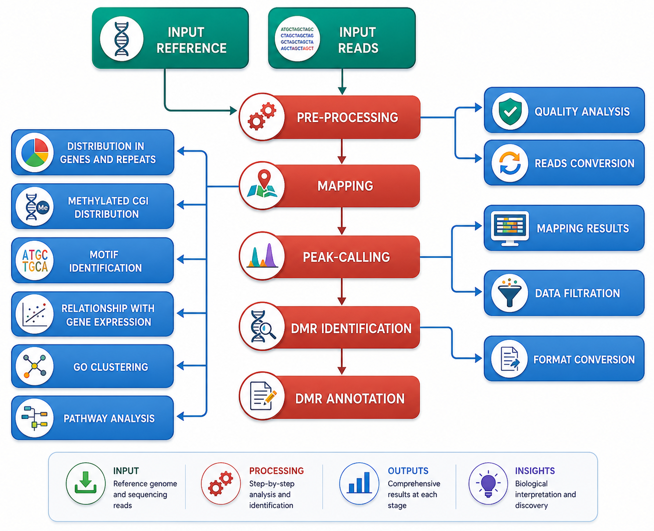
Our end-to-end DNA methylation analysis pipeline transforms raw sequencing or array data into biologically meaningful insights through rigorous quality control, statistical analysis, and functional interpretation.
Our analysis workflow includes:
- • Raw data quality assessment and preprocessing
- • Sequence alignment and methylation calling
- • Array data normalization and quality filtering
- • Genome-wide methylation profiling
- • Identification of differentially methylated cytosines (DMCs)
- • Detection of differentially methylated regions (DMRs)
- • Annotation of methylation sites with genes, promoters, CpG islands, enhancers, and other regulatory elements
- • Differential methylation analysis across experimental groups
- • Functional enrichment and pathway analysis
- • Integration with RNA-Seq and other multi-omics datasets
- • Publication-quality visualization and comprehensive reporting
By integrating DNA methylation profiles with gene expression and other genomic datasets, researchers can identify epigenetic biomarkers, investigate regulatory networks, understand disease-associated epigenetic alterations, and explore mechanisms underlying development, aging, and environmental responses.
Our robust analytical workflows ensure accurate, reproducible, and biologically meaningful results, supporting both basic research and translational studies across biomedical, agricultural, and clinical genomics applications.
Transcription Factor Binding Site Analysis
Deciphering Gene Regulatory Networks
Transcription factors (TFs) are key regulators of gene expression, controlling diverse biological processes by binding to specific DNA sequences. Epigenomic technologies such as ChIP-Seq and ATAC-Seq provide powerful approaches for identifying transcription factor binding sites and understanding genome-wide regulatory mechanisms.
At N2Jenomics Lab Pvt. Ltd., we offer comprehensive transcription factor binding site analysis using advanced computational pipelines that accurately identify protein-DNA interaction sites and regulatory elements across the genome.
Our analysis services include:
- • Genome-wide transcription factor binding site identification
- • ChIP-Seq peak-based TF binding analysis
- • ATAC-Seq footprinting analysis
- • Motif discovery and enrichment analysis
- • Transcription factor occupancy profiling
- • Regulatory network reconstruction
- • Functional annotation of binding sites
- • Integration with RNA-Seq and other multi-omics datasets
Using transcription factor footprinting, regions of reduced chromatin accessibility are analyzed to identify protected DNA sequences that indicate protein binding. When integrated with gene expression data, these analyses reveal how transcription factors coordinate gene regulation under different biological conditions, providing valuable insights into developmental processes, disease mechanisms, and cellular responses.
Peak Calling and Functional Annotation
- Accurate Identification of Functional Genomic Regions
Peak calling is a critical step in epigenomic data analysis that identifies genomic regions enriched for biological signals, such as transcription factor binding events, histone modifications, or accessible chromatin regions.
At N2Jenomics Lab Pvt. Ltd., we employ industry-leading peak-calling algorithms and optimized bioinformatics workflows to accurately detect high-confidence peaks from ChIP-Seq, ATAC-Seq, and other epigenomic datasets.
Our peak analysis workflow includes:
- • High-confidence peak detection
- • Quality assessment and filtering
- • Differential peak analysis
- • Peak annotation with genomic features
- • Association with nearby genes and promoters
- • Annotation of enhancers, CpG islands, and regulatory elements
- • Motif enrichment and transcription factor binding analysis
- • Functional enrichment and pathway analysis
- • Genome browser visualization
- • Publication-ready reports and figures
Comprehensive peak annotation links identified regions to genes, promoters, enhancers, transcription factor binding motifs, and other regulatory elements, enabling researchers to uncover the functional significance of epigenetic modifications.
By combining peak annotation with gene set enrichment, pathway analysis, and transcriptomic data integration, researchers can better understand gene regulatory networks, identify key biological pathways, and discover candidate biomarkers associated with development, disease progression, and therapeutic response.
- Exploratory Data Analysis
Exploratory analysis provides an overview of epigenomic datasets by identifying sample relationships, biological variation, and potential outliers. At N2Jenomics Lab Pvt. Ltd., we use advanced visualization techniques such as PCA, UMAP, and t-SNE to evaluate data quality, assess sample clustering, and explore biological patterns across different tissues, treatments, and experimental conditions.
- Differential Peak Analysis
Differential peak analysis identifies genomic regions exhibiting significant changes in chromatin accessibility, transcription factor binding, or histone modifications between experimental groups. Our analysis includes robust statistical testing, effect size estimation, volcano plots, and functional annotation to reveal biologically meaningful epigenetic alterations.
- RNA-Seq & Epigenomics Integration
Integrating RNA-Seq with epigenomic datasets such as ChIP-Seq, ATAC-Seq, and DNA methylation data provides a comprehensive understanding of gene regulation. Our multi-omics workflows uncover relationships between regulatory elements, transcription factors, enhancers, and gene expression, helping identify key regulatory pathways and candidate biomarkers.
- Multi-Omics Data Integration
We integrate epigenomic, transcriptomic, genomic, and proteomic datasets to provide a systems-level understanding of biological processes. Our computational pipelines reveal complex molecular interactions, regulatory networks, and disease-associated pathways that are difficult to identify using individual datasets alone.
- Machine Learning & Bioinformatics Data Mining
Our advanced machine learning and bioinformatics approaches identify hidden patterns, biomarkers, and predictive signatures within large-scale epigenomic datasets. These analyses support disease research, biomarker discovery, functional genomics, and precision medicine applications.
Why Choose N2Jenomics Lab Pvt. Ltd.?
N2Jenomics Lab Pvt. Ltd. provides end-to-end epigenomics bioinformatics solutions backed by experienced scientists, validated analytical pipelines, and cutting-edge computational technologies.
Our Advantages
- • Experienced bioinformatics experts
- • Customized analysis tailored to your research objectives
- • Support for all major epigenomic platforms (ChIP-Seq, ATAC-Seq, WGBS, RRBS, BSAS, EPIC, MeDIP-Seq, RNA-Seq)
- • Comprehensive quality control and statistical analysis
- • Integrative multi-omics workflows
- • Machine learning-based biomarker discovery
- • Publication-ready reports, figures, and visualizations
- • Manuscript preparation support
- • Fast turnaround time
- • Secure, confidential, and reproducible data analysis
Accelerate Your Epigenomics Research
Whether your study focuses on chromatin accessibility, transcription factor binding, DNA methylation, differential epigenetic analysis, or integrated multi-omics research, N2Jenomics Lab Pvt. Ltd. delivers accurate, scalable, and publication-ready bioinformatics solutions that transform complex epigenomic data into meaningful biological discoveries.


