Amplicon Sequencing Services Home  >  Genomics Sequencing  > Amplicon Sequencing Services
Amplicon Sequencing Services: High-Resolution Genetic and Microbiome Analysis

At N2Jenomics Lab Pvt. Ltd., we provide high-throughput Amplicon Sequencing services for precise analysis of targeted genomic regions. Our flexible sequencing workflows support diverse research applications, including genetic variant detection, microbial community profiling, targeted gene analysis, and genome editing validation. Using advanced NGS platforms and comprehensive bioinformatics, we deliver accurate, reliable, and reproducible results.


Key Advantages

  • • Supports a wide range of sample types and amplicon sizes

  • • Ultra-deep sequencing for highly sensitive variant detection
  • • Flexible bioinformatics analysis and customized data reports
  • • End-to-end workflow with expert technical and analytical support
Amplicon Sequencing Services: High-Resolution Genetic and Microbiome Analysis
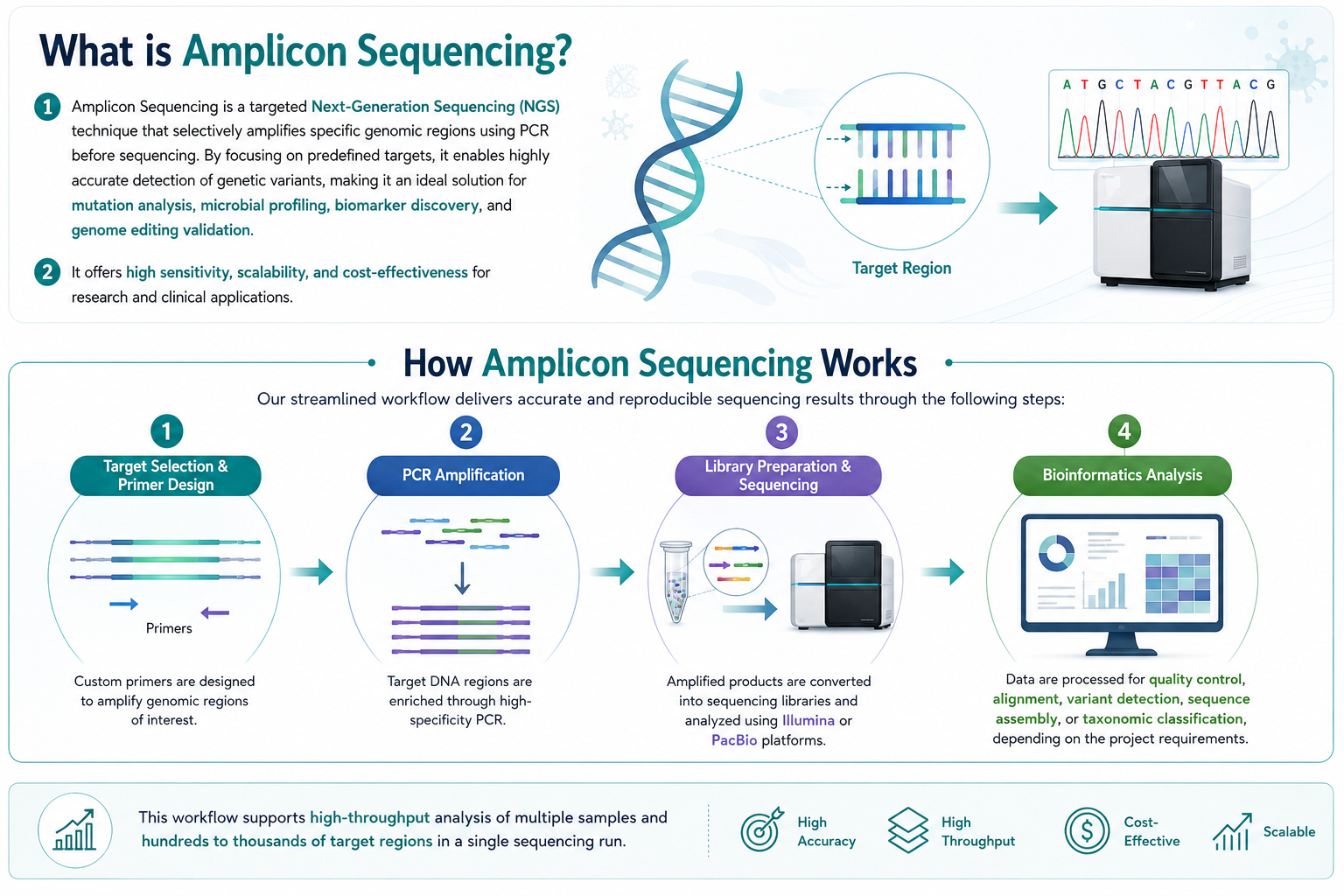
  • What is Amplicon Sequencing?

  • Amplicon Sequencing is a targeted Next-Generation Sequencing (NGS) technique that selectively amplifies specific genomic regions using PCR before sequencing. By focusing on predefined targets, it enables highly accurate detection of genetic variants, making it an ideal solution for mutation analysis, microbial profiling, biomarker 
  • discovery, and genome editing validation.
  •  

  • How Amplicon Sequencing Works

  • Our streamlined workflow delivers accurate and reproducible sequencing results through the following steps:
  • • Target Selection & Primer Design – Custom primers are designed to amplify genomic regions of interest.

  • • PCR Amplification – Target DNA regions are enriched through high-specificity PCR.
  • • Library Preparation & Sequencing – Amplified products are converted into sequencing libraries and analyzed using Illumina or PacBio platforms.
  • • Bioinformatics Analysis – Data are processed for quality control, alignment, variant detection, sequence assembly, or taxonomic classification, depending on the project requirements.
  • This workflow supports high-throughput analysis of multiple samples and hundreds to thousands of target regions in a single sequencing run.
  •  

  • Why Choose Amplicon Sequencing?

  • Amplicon Sequencing offers a fast, accurate, and cost-effective approach for targeted genomic analysis. At N2Jenomics Lab Pvt. Ltd., we provide customized solutions from assay design through bioinformatics analysis to meet diverse research needs.
  • • High Accuracy

  • Target-specific amplification delivers deep sequencing coverage for reliable detection of SNPs, InDels, and other genetic variants.
  • • High Throughput

  • Simultaneously analyze large numbers of samples and target regions, making it ideal for population studies, microbial profiling, and large-scale screening.
  • • Flexible Platform Options

  • Compatible with both Illumina short-read and PacBio long-read sequencing technologies, supporting a broad range of amplicon sizes and applications.
  • • Sensitive Variant Detection

  • Ultra-deep sequencing enables accurate identification of low-frequency mutations, mixed microbial populations, and rare genetic variants.re not missed.


Amplicon Sequencing vs. Other NGS Methods

Selecting the right sequencing strategy depends on your research goals, target region, and required sequencing depth.

FeatureAmplicon SequencingTargeted Capture SequencingWhole Genome Sequencing (WGS)
Target RegionSpecific PCR-amplified regionsTargeted genomic panelsEntire genome
Sequencing DepthUltra-deep (>1000×)Moderate to high (200–800×)Moderate (~30×)
Data VolumeLowModerateHigh
Variant DetectionExcellent for rare variantsHigh sensitivityBest for genome-wide analysis
Common ApplicationsMutation detection, microbiome profiling, CRISPR validationDisease gene panels, targeted researchPopulation genomics, structural variation, genome discovery

Sequencing Platform Options

We offer multiple sequencing strategies optimized for different amplicon sizes and research applications.

ServiceAmplicon SizePlatformRecommended Applications
Standard Amplicon Sequencing100–250 bpIllumina MiSeqSNP genotyping, targeted mutation analysis, genome editing validation
Medium-Length Amplicon Sequencing250–550 bpIllumina MiSeq / NextSeq16S V3–V4 profiling, immune repertoire analysis
Long Amplicon Sequencing550 bp–10 kbPacBio HiFiFull-length 16S/ITS sequencing, variant phasing, complex amplicons

Platform Highlights

  • • Illumina Sequencing – High accuracy and high-throughput performance for short- and medium-length amplicons.

  • • PacBio HiFi Sequencing – Long, highly accurate reads for full-length amplicons, structural variant detection, and haplotype analysis.


Our Amplicon Sequencing Workflow

Our standardized workflow delivers high-quality sequencing data from project planning through final reporting.

• Project consultation and experimental design

• Sample quality assessment

• Library preparation

• Illumina or PacBio sequencing

• Bioinformatics analysis

• Quality assessment and final report delivery


Research Applications

Amplicon Sequencing supports a wide range of research areas, including:

  • • Genetic variant detection
  • • Microbiome profiling (16S, 18S, ITS)
  • • Immune repertoire sequencing
  • • CRISPR and genome editing validation
  • • Functional gene analysis
  • • Plasmid library characterization
  • • Biomarker discovery
  • • Population and clinical genomics


Bioinformatics Analysis

Our customizable bioinformatics pipeline supports both short-read and long-read sequencing projects.

• Illumina Analysis

  • - Quality control and read preprocessing
  • - Variant detection (SNPs and InDels)
  • - Taxonomic classification
  • - Alpha and beta diversity analysis
  • - Functional prediction
  • - Publication-ready visualizations and reports

• PacBio Long-Read Analysis

  • - HiFi read correction and quality assessment
  • - Full-length amplicon assembly
  • - Variant phasing and structural variant detection
  • - High-resolution taxonomic annotation
  • - Functional analysis
  • - Comprehensive data visualization and reporting


Sample Requirements

Sample TypeRecommended Input
Purified PCR Products≥500 ng (1 µg recommended)
Genomic DNA≥500 ng, OD260/280: 1.8–2.0
Plasmid DNAHigh-quality purified DNA
Fragmented DNACompatible with target amplicon design
Restriction Digest ProductsComplete digestion with minimal contaminants

Note: Sample input requirements may vary depending on the sequencing strategy and project design. Please contact our technical team for project-specific recommendations.


Why Choose N2Jenomics Lab Pvt. Ltd.?

  • • Advanced Illumina and PacBio sequencing platforms
  • • Support for short-, medium-, and long-amplicon sequencing
  • • High sequencing accuracy and ultra-deep coverage
  • • Customized bioinformatics and data visualization
  • • Flexible workflows tailored to diverse research applications
  • • Experienced genomics and bioinformatics experts
  • • End-to-end support from experimental design to final data delivery


1. How is Amplicon Sequencing different from Targeted Sequencing?

Amplicon Sequencing uses PCR to amplify specific genomic regions before sequencing, providing ultra-deep coverage and excellent sensitivity for predefined targets. Targeted Sequencing, on the other hand, typically uses hybrid capture to enrich larger genomic regions or multiple genes, making it suitable for broader genomic analysis.


2. What are the major applications of Amplicon Sequencing?

Amplicon Sequencing is widely used for:

  • • Detection of SNPs, InDels, and other genetic variants
  • • Microbiome profiling using 16S, 18S, and ITS markers
  • • Cancer mutation analysis
  • • Inherited disease research
  • • CRISPR and genome editing validation
  • • Environmental and biodiversity studies


3. How does Amplicon Sequencing compare with Whole Genome Sequencing (WGS)?

Amplicon Sequencing focuses on selected genomic regions, offering high sequencing depth, lower cost, and greater sensitivity for targeted variant detection. In contrast, WGS analyzes the entire genome, making it ideal for comprehensive genomic discovery but requiring more sequencing data and analysis.


4. How are target regions selected?

Target regions are chosen based on the objectives of the study, such as disease-associated genes, functional genomic regions, genetic markers, or microbial marker genes. Our experts work with clients to design primers and optimize target selection for each project.


5. What bioinformatics analyses are included?

Depending on the application, our analysis pipeline may include:

  • • Quality control and read processing
  • • SNP and InDel detection
  • • Taxonomic classification
  • • Microbial diversity analysis
  • • Phylogenetic analysis
  • • Functional annotation and customized reporting


6. Can Amplicon Sequencing detect rare genetic variants?

Yes. Ultra-deep sequencing provides high sensitivity for detecting low-frequency mutations and rare variants, making it suitable for applications such as cancer research, microbial profiling, and targeted mutation analysis.


7. How do you improve sequencing performance in GC-rich regions?

Our optimized workflows are designed to maximize sequencing accuracy in challenging, GC-rich regions through:

  • • Optimized PCR and library preparation protocols to minimize GC bias
  • • Rigorous quality control throughout sample processing
  • • Advanced bioinformatics methods to improve sequence accuracy and variant detection
Address: Registered Office: 138, Patparganj Industrial Area, New Delhi – 110092, India
Email: info@n2jenomicslab.com
Phone: +91-8287121443 +91-9870548477
Operational Address: National Institute of Plant Genome Research (BRIC - NGGF) Lab No. 206 and 207, Aruna Asaf Ali Marg, P.O. Box No. 10531, New Delhi – 110067, India
Follow Us:
15,848 Total Visitors
Copyright © 2026 | All rights reserved N2Jenomics Lab Pvt Ltd