At N2Jenomics Lab Pvt. Ltd., we offer comprehensive Viral Genome Sequencing services powered by advanced Illumina short-read and PacBio long-read sequencing technologies. Our integrated laboratory and bioinformatics workflows enable accurate viral genome sequencing, high-quality genome assembly, mutation analysis, and detailed genomic characterization for both DNA and RNA viruses.
Whether your project requires reference-based analysis or de novo genome assembly, we deliver reliable, research-grade data with rapid turnaround and comprehensive analytical support.
What is Viral Genome Sequencing?
Viral Genome Sequencing is the process of determining the complete genetic sequence of a virus to understand its genetic composition, diversity, and evolution. By decoding viral DNA or RNA, researchers can identify mutations, monitor viral transmission, investigate evolutionary relationships, and characterize emerging variants.
Combining high-throughput sequencing with advanced bioinformatics enables comprehensive analysis of viral genomes, supporting infectious disease research, epidemiological studies, vaccine development, and public health surveillance.
Our Viral Genome Sequencing Solutions
We provide complete end-to-end sequencing services, including:
• DNA and RNA virus genome sequencing
• Illumina short-read sequencing
• PacBio long-read sequencing
• Reference-guided genome analysis
• De novo genome assembly
• Variant detection and mutation profiling
• Genome annotation and quality assessment
• Comprehensive bioinformatics analysis
• Customized project reporting
Our experienced genomics specialists follow rigorous quality control procedures to ensure accurate, reproducible, and high-confidence results.
Key Benefits
• High-quality sequencing with stringent quality assurance
• Support for both DNA and RNA viruses
• Flexible reference-based and de novo analysis workflows
• Accurate detection of SNPs, InDels, and structural variants
• Sensitive identification of low-frequency mutations
• Scalable solutions for projects of any size
• Expert bioinformatics support and detailed reports
• Fast turnaround and cost-effective service
Applications
Our Viral Genome Sequencing services are widely used for:
• Viral genome characterization
• Comparative and evolutionary genomics
• Molecular epidemiology
• Phylogenetic analysis
• Outbreak investigation and genomic surveillance
• Emerging variant identification
• Vaccine and therapeutic research
• Antiviral resistance studies
• Host-pathogen interaction research
• Environmental and wastewater surveillance
• Viral metagenomics
• Public health and infectious disease research
Viral Genome Sequencing Workflow
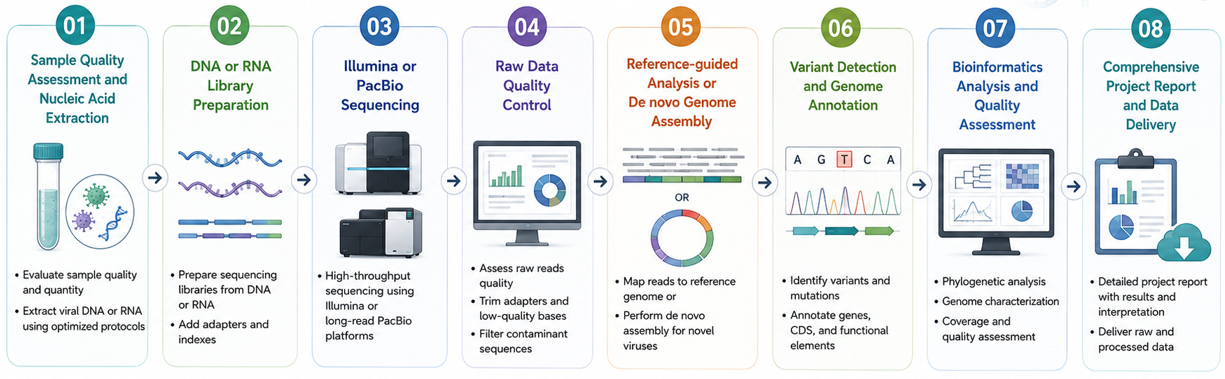
Our standardized workflow ensures consistent, high-quality sequencing results from sample submission to final data delivery.
• Sample quality assessment and nucleic acid extraction
• DNA or RNA library preparation
• Illumina or PacBio sequencing
• Raw data quality control
• Reference-guided analysis or de novo genome assembly
• Variant detection and genome annotation
• Bioinformatics analysis and quality assessment
• Comprehensive project report and data delivery
Service Specifications
Sample requirements
Viral DNA/cDNA amount: 1 ug
Genomic DNA ≥ 1 µg, Concentration ≥ 20 ng/µl
Sequencing
Illumina Platform, Library size: 300-500 bp, PE 250, 100X
PacBio Platform, Library size: 2 K, 1G
MGI DNBSEQ-T7/DNBSEQ-G400
Bioinformatics Analysis
Data quality control
Genome assembly
Protein coding gene prediction
Protein coding gene annotation
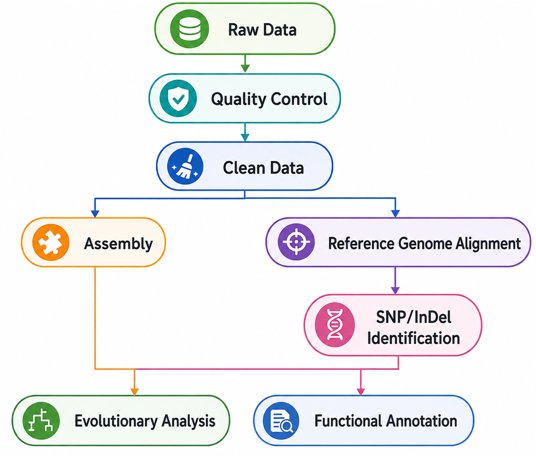
Analysis Pipeline
Project Deliverables
Every Viral Genome Sequencing project includes a comprehensive set of deliverables designed to support downstream research and data interpretation.
• Raw sequencing data in standard formats
• Quality-controlled sequencing results
• Comprehensive bioinformatics analysis report
• Genome assembly and annotation (where applicable)
• Variant analysis and genomic insights (based on project scope)
• Customized project documentation and reports tailored to your research objectives
1. What sequencing methods are available for viral genome analysis?
The choice of sequencing approach depends on the research objective and sample type. Common methods include Whole Genome Sequencing (WGS) for complete viral genome analysis, Targeted Sequencing for selected genomic regions, Metagenomic Sequencing for detecting viruses in complex samples, and Metatranscriptomic Sequencing for studying viral RNA and gene expression.
2. What bioinformatics analyses are performed after sequencing?
Following sequencing, the data undergoes a comprehensive bioinformatics workflow that typically includes quality control, read filtering, reference genome alignment or de novo assembly, variant detection, genome annotation, and functional analysis. A detailed report with quality metrics and genomic insights is provided upon project completion.
3. Why is viral genome sequencing important?
Viral genome sequencing helps researchers monitor viral evolution, identify emerging variants, and investigate transmission patterns. It is widely used for infectious disease research, outbreak investigations, genomic surveillance, vaccine and therapeutic development, and epidemiological studies, providing critical insights that support public health and biomedical research.
Address:Registered Office: 138, Patparganj Industrial Area, New Delhi – 110092, India
Operational Address: National Institute of Plant Genome Research (BRIC - NGGF)
Lab No. 206 and 207, Aruna Asaf Ali Marg, P.O. Box No. 10531,
New Delhi – 110067, India