High-Resolution Epigenetic Profiling at Single-Cell Resolution
DNA methylation is one of the most important epigenetic modifications regulating gene expression, cellular identity, and genome stability. Alterations in DNA methylation patterns are associated with numerous biological processes, including embryonic development, genomic imprinting, X-chromosome inactivation, aging, and disease progression.
N2Jenomics Lab Pvt. Ltd. offers comprehensive Single-Cell DNA Methylation Sequencing services that combine advanced Single-Cell Whole Genome Bisulfite Sequencing (scWGBS) library preparation with high-throughput Illumina Next-Generation Sequencing (NGS). Our end-to-end workflow enables genome-wide methylation profiling at single-cell resolution, allowing researchers to uncover cellular heterogeneity and epigenetic variation that are often concealed by conventional bulk methylation analyses.
Introduction to Single-Cell DNA Methylation Sequencing
Conventional DNA methylation profiling methods, including Whole Genome Bisulfite Sequencing (WGBS), Reduced Representation Bisulfite Sequencing (RRBS), and Methylated DNA Immunoprecipitation Sequencing (MeDIP-Seq), provide average methylation profiles across large populations of cells. While highly informative, these bulk approaches cannot resolve methylation differences between individual cells.
Single-Cell DNA Methylation Sequencing overcomes this limitation by profiling the methylome of individual cells, enabling detailed investigation of epigenetic heterogeneity, lineage relationships, and cell-specific regulatory mechanisms.
Our optimized workflow utilizes post-bisulfite library preparation, allowing efficient processing of single cells, ultra-low DNA input, and other precious biological samples. This approach provides reliable genome-wide methylation data suitable for advanced epigenetic studies.
Advantages of Single-Cell DNA Methylation Sequencing
• Single-Cell Epigenetic Resolution
Profile genome-wide DNA methylation patterns at the level of individual cells, providing unprecedented insights into cellular diversity and epigenetic regulation.
• Characterization of Cellular Heterogeneity
Identify epigenetically distinct cell populations within complex tissues that are not detectable using bulk methylation sequencing.
• Study Cell State Transitions
Track dynamic methylation changes during cellular differentiation, lineage commitment, and developmental processes to better understand cell fate decisions.
• Functional Epigenetic Insights
Compare methylation profiles across individual cells to investigate regulatory mechanisms influencing gene expression, cellular function, and disease progression.
• Ultra-Low DNA Input Compatibility
Optimized library preparation enables reliable methylation analysis from single cells and extremely limited DNA samples, making the workflow suitable for rare or precious specimens.
• Advanced Bioinformatics Analysis
Comprehensive bioinformatics pipelines provide detailed methylation profiling, differential methylation analysis, functional annotation, and publication-ready visualizations.
• High-Quality Sequencing Data
Optimized workflows produce high-quality sequencing libraries with robust mapping efficiency, reliable genome coverage, and reproducible methylation profiles comparable to conventional WGBS methods.
Applications of Single-Cell DNA Methylation Sequencing
Single-cell methylation analysis has become an indispensable tool for investigating epigenetic regulation across diverse areas of biomedical research.
• High-throughput sequencing using Illumina platforms.
• Generation of genome-wide methylation data.
Step 5: Bioinformatics Analysis
Our comprehensive analysis pipeline includes:
• Sequencing quality assessment.
• Read alignment.
• Methylation calling.
• Genome-wide methylation profiling.
• Differential methylation analysis.
• Identification of Differentially Methylated Regions (DMRs).
• Functional enrichment analysis.
• Integration with transcriptomic or other multi-omics datasets.
• Publication-ready visualizations and detailed reports.
Service Specification
Sample Requirements
96-well plates of live cells suspension are recommended for this procedure.
Frozen cells in specifically frozen lysates can also be used as starting material.
ScWGBS Sample Type: Cell lines, primary cells, fresh tissue, frozen cells; Recommended Quantity & Quality: Use 200µl PCR tubes to store cells (single or multiple cells), 5µl of lysate per tube, and no more than 1µl of buffer when collecting cells. ≥3 biological replicates.
ScRRBS Sample Type: Cell lines, primary cells, fresh tissue, frozen cells; Recommended Quantity & Quality: Use 200µl PCR tubes to store cells (single or multiple cells), 5µl of lysate per tube, and no more than 1µl of buffer when collecting cells. ≥3 biological replicates.
>100 pg extracted DNA should be free of enzymatic inhibitors and can be suspended in water, TE, or a low salt buffer.
Sequencing
Flexible service options include HiSeq X
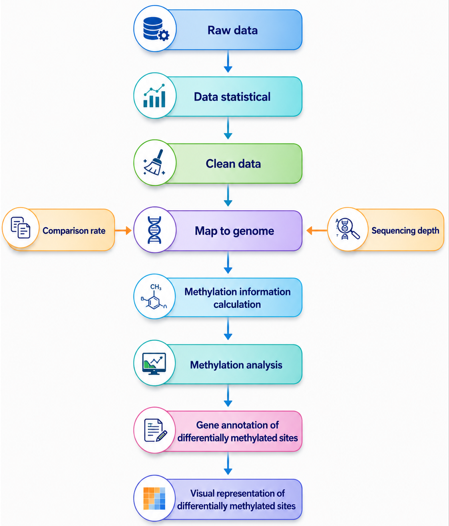
Bioinformatics Analysis
Alignment against a reference genome
Sequence depth and coverage analysis
mC calling
Methylation level analysis
Global trends of methylome
Methylation density analysis
Differentially Methylated Regions (DMRs) analysis
DMR annotation and enrichment analysis (GO/KEGG)
Clustering analysis
Analysis Pipeline
Deliverables
• The original sequencing data
• Experimental results
• Data analysis report
• Details in Single-cell DNA Methylation Sequencing for your writing (customization)
1. What are the advantages of Single-Cell DNA Methylation Sequencing?
Single-Cell DNA Methylation Sequencing enables researchers to examine DNA methylation patterns at the resolution of individual cells, providing insights that cannot be obtained through conventional bulk methylation analysis.
Key advantages include:
• Characterization of cellular heterogeneity by identifying epigenetically distinct cell populations within complex tissues.
• Detection of rare cell populations that may be overlooked in bulk sequencing experiments.
• Monitoring of dynamic methylation changes during development, differentiation, aging, and disease progression.
• Cell-specific epigenetic profiling for a deeper understanding of gene regulation and cellular identity.
• Improved investigation of disease mechanisms, particularly in cancer, neurological disorders, and immune-related diseases.
• Support for precision medicine through the discovery of novel biomarkers and therapeutic targets.
By resolving methylation profiles at the single-cell level, this technology provides a comprehensive view of epigenetic diversity and cellular function.
2. What challenges are associated with Single-Cell DNA Methylation Sequencing?
Although single-cell methylation sequencing offers significant advantages, it also presents several technical and analytical challenges.
These include:
• Isolation of high-quality individual cells or nuclei.
• Extremely limited DNA input from each cell, requiring highly sensitive library preparation methods.
• Potential DNA degradation during bisulfite conversion.
• Increased sequencing costs compared with conventional bulk methylation studies.
• Sparse methylation data resulting from limited genomic coverage per individual cell.
• Complex bioinformatics workflows for methylation calling, quality control, and downstream analysis.
• High computational requirements for large-scale single-cell datasets.
• Advances in sequencing chemistry, library preparation technologies, and bioinformatics tools continue to improve data quality, throughput, and analytical accuracy.
3. How is Single-Cell DNA Methylation Sequencing advancing biological and disease research?
Single-cell DNA methylation sequencing has become a powerful tool for understanding how epigenetic regulation influences cellular behavior in both healthy and diseased tissues.
By profiling methylation patterns in individual cells, researchers can:
• Investigate cell fate decisions during development.
• Understand mechanisms of cellular differentiation.
• Identify potential therapeutic targets for precision medicine.
These insights are helping researchers better understand the molecular basis of complex diseases while supporting the development of more targeted diagnostic and therapeutic strategies.
4. What are the differences between single-cell RRBS and single-cell WGBS?
Both Single-Cell Reduced Representation Bisulfite Sequencing (scRRBS) and Single-Cell Whole Genome Bisulfite Sequencing (scWGBS) are widely used for DNA methylation analysis, but they differ in genome coverage, sequencing depth, cost, and research applications.
Feature
Single-Cell RRBS
Single-Cell WGBS
Genome Coverage
Targets CpG-rich regions such as promoters and CpG islands.
Provides genome-wide methylation profiling across nearly the entire genome.
Sequencing Depth
Higher read depth within targeted regions due to focused sequencing.
Sequencing reads are distributed across the whole genome, resulting in broader coverage with comparatively lower depth per region.
Resolution
Excellent for analyzing methylation in CpG islands and promoter regions but limited outside targeted regions.
Captures methylation patterns across CpG islands, gene bodies, intergenic regions, and other regulatory elements, providing a more comprehensive epigenetic landscape.
Data Volume
Generates smaller datasets, making storage, processing, and analysis relatively straightforward.
Produces substantially larger datasets that require greater computational resources and advanced bioinformatics pipelines.
Cost
Generally more cost-effective because only selected genomic regions are sequenced.
Typically more expensive due to whole-genome sequencing requirements.
Best Suited For
Focused studies of promoter methylation, CpG islands, and targeted epigenetic investigations.
Comprehensive genome-wide methylation studies, cellular heterogeneity analysis, epigenetic landscape mapping, and discovery of novel methylation signatures.
Address:Registered Office: 138, Patparganj Industrial Area, New Delhi – 110092, India
Operational Address: National Institute of Plant Genome Research (BRIC - NGGF)
Lab No. 206 and 207, Aruna Asaf Ali Marg, P.O. Box No. 10531,
New Delhi – 110067, India