Bacterial Whole Genome de novo Sequencing
Home
>
PacBio SMRT Sequencing
> Bacterial Whole Genome de novo Sequencing
Bacterial Whole Genome de novo Sequencing for Accurate Genome Reconstruction
Our advanced Bacterial Whole Genome de novo Sequencing service delivers high-quality genome assembly and comprehensive functional analysis, enabling accurate characterization of bacterial genomes, gene functions, and evolutionary relationships.
Key Features
• Long reads (15–25 kb) for reliable assembly across repetitive genomic regions.
• >99% genome continuity with highly accurate, gap-free assemblies.
• Low GC bias for consistent coverage of GC-rich and GC-poor regions.
• High-confidence plasmid detection with >98% completeness.
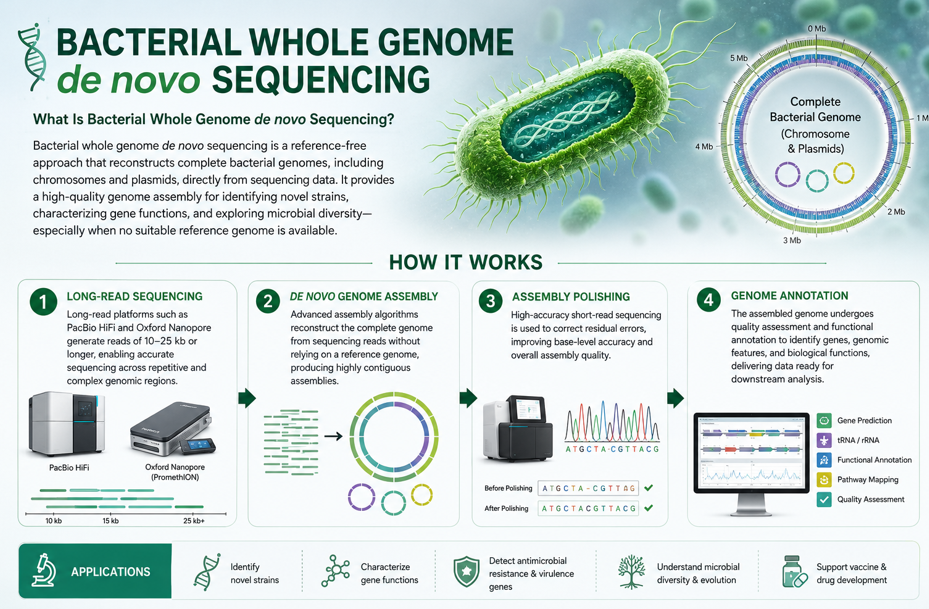
Bacterial whole genome de novo sequencing is a reference-free approach that reconstructs complete bacterial genomes, including chromosomes and plasmids, directly from sequencing data. It provides a high-quality genome assembly for identifying novel strains, characterizing gene functions, and exploring microbial diversity especially when no suitable reference genome is available.
How It Works
1. Long-Read Sequencing
Long-read platforms such as PacBio HiFi and Oxford Nanopore generate reads of 10–25 kb or longer, enabling accurate sequencing across repetitive and complex genomic regions.
2. denovo Genome Assembly
Advanced assembly algorithms reconstruct the complete genome from sequencing reads without relying on a reference genome, producing highly contiguous assemblies.
3. Assembly Polishing
High-accuracy short-read sequencing is used to correct residual errors, improving base-level accuracy and overall assembly quality.
4. Genome Annotation
The assembled genome undergoes quality assessment and functional annotation to identify genes, genomic features, and biological functions, delivering data ready for downstream analysis.
Bacterial whole genome de novo sequencing enables complete, reference-free genome assembly, making it ideal for novel or genetically diverse bacterial strains. It provides accurate genome reconstruction, identifies complex genomic variations, and supports comprehensive functional analysis.
Key Benefits
• Complete Genome Assembly – Generate high-quality chromosome and plasmid assemblies without a reference genome.
- Illumina NovaSeq – High-depth short reads for assembly polishing and error correction.
• Recommended Coverage
- PacBio HiFi: >100×
- Illumina: >50×
• Quality Metrics
- HiFi read accuracy >99.9%
- Illumina Q30 ≥90%
- High assembly continuity and completeness
Bioinformatics Analysis
• Standard Analysis
- Raw data quality control
- de novo genome assembly
- Error correction and polishing
- Gene prediction
- Functional annotation (GO, KEGG, eggNOG)
- Repeat sequence and CRISPR identification
• Advanced Analysis
- Prophage and viral sequence prediction
- Virulence and antimicrobial resistance gene analysis
- CAZyme annotation
- Transmembrane protein and signal peptide prediction
- Comparative genomics, phylogenetic analysis, gene family clustering, and synteny analysis
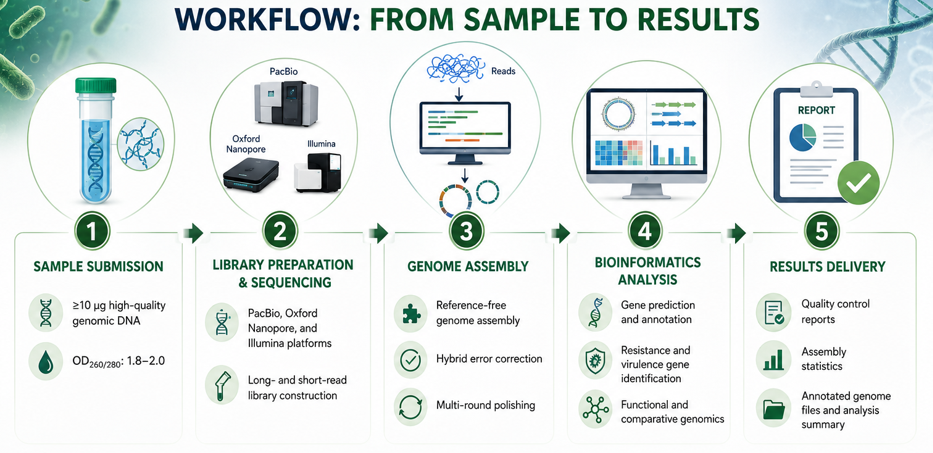
Sample Requirements
Parameter
Requirement
Sample Type
Genomic DNA
DNA Amount
≥10 μg
DNA Concentration
≥80 ng/μL
DNA Purity
OD260/280: 1.8–2.0
DNA Integrity
Intact DNA with no visible degradation or RNA contamination
Sample Submission Guidelines
• Store samples in DNase-free, low-binding centrifuge tubes (e.g., 1.5 mL Eppendorf tubes).
• Ship samples on ice packs for short distances or dry ice for extended transport.
• Label each sample clearly with a unique identifier.
Applications of Bacterial Whole Genome de novo Sequencing
Our service supports diverse bacterial genomics research, including:
• Antimicrobial Resistance Research – Detect resistance genes and genomic islands associated with antibiotic resistance.
• Virulence Analysis – Investigate virulence factors and their evolutionary dynamics.
• Industrial Microbiology – Identify metabolic genes for strain improvement and enhanced production.
• Environmental Microbiology – Explore genetic adaptations that enable survival in diverse environments.
• Novel Species Discovery – Generate complete genomes for microbial classification and taxonomic studies.
Why Choose N2Jenomics Lab Pvt. Ltd.?
• Integrated Sequencing Technologies
Leverage PacBio HiFi, Oxford Nanopore, and Illumina platforms for accurate and high-quality genome assemblies.
• Optimized Assembly Pipeline
Customized assembly workflows with hybrid error correction ensure highly accurate and complete genome reconstruction.
• Comprehensive Bioinformatics
End-to-end analysis including genome assembly, annotation, comparative genomics, resistance and virulence profiling, and pathway analysis.
• Stringent Quality Control
Standardized quality checks at every stage—from sample processing to final data delivery—for reliable and reproducible results.
• Publication-Ready Reports
Receive clear reports with assembly statistics, visual summaries, and annotated datasets for downstream analysis and publication.
• Expert Technical Support
Our genomics specialists provide guidance on experimental design, data interpretation, and post-analysis support throughout your project.
1. How is the quality of a bacterial genome assembly evaluated?
Assembly quality is typically assessed using metrics such as N50, genome completeness, number of scaffolds/contigs, GC content, ambiguous bases (N%), and total assembled genome size.
2. Can a gap-free bacterial genome assembly be achieved?
Yes. By combining long-read sequencing (PacBio HiFi or Oxford Nanopore) with short-read polishing (Illumina), most bacterial genomes can be assembled into highly complete, near gap-free sequences. Additional validation can be performed when required.
3. Is long-read sequencing alone sufficient for complete bacterial genome assembly?
Long-read sequencing provides excellent genome continuity, but combining it with high-accuracy short-read data improves base-level accuracy and helps recover small plasmids or challenging genomic regions.
4. How is assembly accuracy ensured?
Assembly accuracy is enhanced through a multi-step workflow that includes long-read error correction, de novo genome assembly, iterative polishing, and final refinement using high-quality short-read sequencing. This approach delivers highly accurate genome assemblies.
5. How do long reads improve assembly of repetitive regions?
Long reads can span repetitive DNA sequences that are difficult to resolve with short-read technologies, resulting in more contiguous assemblies and improved reconstruction of complex genomic regions.
6. Can DNA methylation be analyzed during sequencing?
Yes. PacBio HiFi sequencing can directly detect DNA base modifications, such as 6mA and 4mC, without requiring additional library preparation or separate sequencing experiments.
7. Does extreme GC content affect sequencing quality?
Modern long-read sequencing platforms are designed to minimize GC bias, providing consistent genome coverage across both GC-rich and GC-poor bacterial genomes for reliable assembly results.
Address:Registered Office: 138, Patparganj Industrial Area, New Delhi – 110092, India
Operational Address: National Institute of Plant Genome Research (BRIC - NGGF)
Lab No. 206 and 207, Aruna Asaf Ali Marg, P.O. Box No. 10531,
New Delhi – 110067, India