Hi-C Sequencing Service: Unlocking the 3D Architecture of Genomes
At N2Jenomics Lab Pvt. Ltd., we provide advanced Hi-C Sequencing services to investigate the three-dimensional (3D) organization of the genome through high-throughput chromosome conformation capture technology. By mapping chromatin interactions across the genome, our solutions help researchers uncover regulatory mechanisms, improve genome assemblies, and gain deeper insights into genome function, disease biology, and synthetic biology.
Key Advantages
• Chromosome-Scale Genome Assembly – Generate highly accurate chromosome-level assemblies and scaffolds.
• 3D Genome Analysis – Reveal chromatin architecture and long-range genomic interactions.
• Multi-Omics Integration – Combine Hi-C data with genomic, transcriptomic, and epigenomic datasets for comprehensive biological insights.
• Versatile Applications – Ideal for functional genomics, genome assembly, evolutionary biology, synthetic biology, and biomedical research.
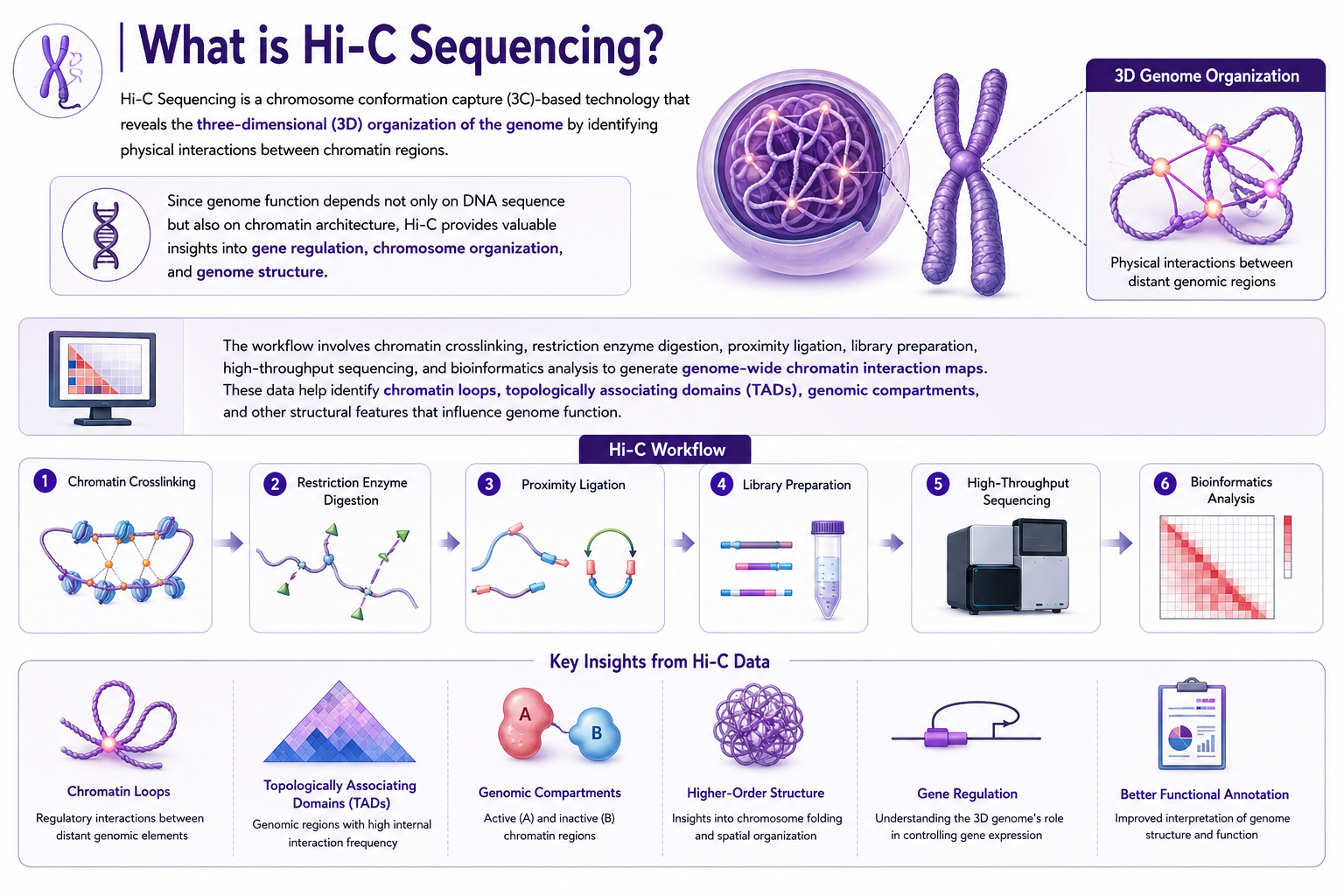
Hi-C Sequencing is a chromosome conformation capture (3C)-based technology that reveals the three-dimensional (3D) organization of the genome by identifying physical interactions between chromatin regions. Since genome function depends not only on DNA sequence but also on chromatin architecture, Hi-C provides valuable insights into gene regulation, chromosome organization, and genome structure.
The workflow involves chromatin crosslinking, restriction enzyme digestion, proximity ligation, library preparation, high-throughput sequencing, and bioinformatics analysis to generate genome-wide chromatin interaction maps. These data help identify chromatin loops, topologically associating domains (TADs), genomic compartments, and other structural features that influence genome function.
Applications of Hi-C Sequencing
Hi-C Sequencing supports a broad range of research applications, including:
• Chromosome-Level Genome Assembly and scaffold construction
• 3D Genome Organization and chromatin interaction analysis
• Gene Regulation through enhancer-promoter interaction mapping
• Haplotype Phasing and structural variation analysis
• Cancer and Disease Research using integrated multi-omics approaches
• Developmental Biology and cellular differentiation studies
• Plant Genomics for stress response and trait discovery
• Microbial Genome Organization and host-microbe interaction studies
• Synthetic Biology and engineered genome analysis
• Comparative and Pan-Genome Research
Hi-C Sequencing Service Options
Service
Recommended For
Key Advantage
Standard Hi-C
Chromosome assembly and genome architecture studies
Genome-wide chromatin interaction analysis
Capture Hi-C
Targeted genomic regions and disease-associated loci
High-resolution analysis of selected regions
Meta Hi-C
Complex microbial communities
Improved metagenomic assembly and host-plasmid association
Hi-C Sequencing Workflow
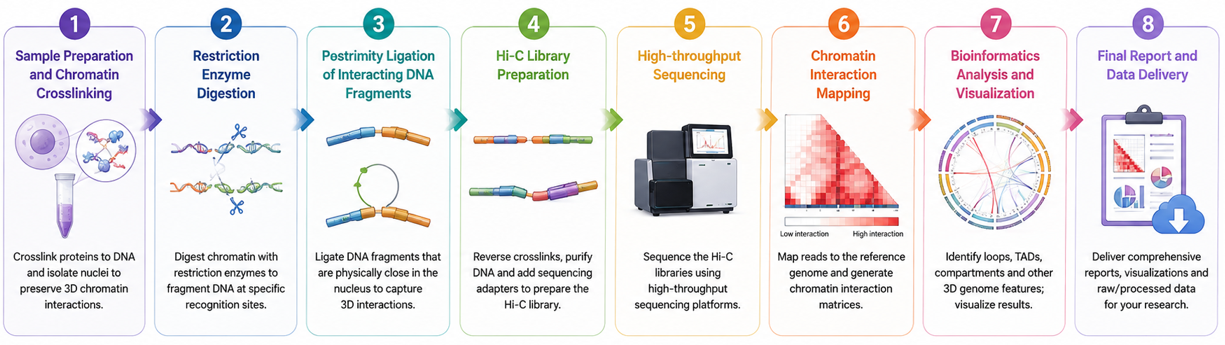
Our end-to-end workflow is designed to generate accurate and reproducible chromatin interaction data.
• Sample preparation and chromatin crosslinking
• Restriction enzyme digestion
• Proximity ligation of interacting DNA fragments
• Hi-C library preparation
• High-throughput sequencing
• Chromatin interaction mapping
• Bioinformatics analysis and visualization
• Final report and data delivery
Bioinformatics Analysis
Our comprehensive analysis pipeline includes:
• Standard Analysis
- Raw data quality assessment
- Chromatin interaction heatmaps
- A/B compartment identification
- TAD detection and boundary analysis
- Chromosome interaction statistics
• Advanced Analysis
- Differential chromatin interaction analysis
- Multi-omics integration with RNA-seq, ATAC-seq, and WGS
- 3D genome reconstruction
- Customized downstream analysis based on research objectives
Deliverables
Each project includes:
• Raw sequencing data (FASTQ)
• Processed alignment files (BAM)
• Chromatin interaction matrices
• Heatmaps, Circos plots, and TAD visualizations
• Comprehensive bioinformatics report
• Quality control metrics
• Project documentation and data interpretation support
Sample Requirements
Sample Type
Minimum Requirement
Cell Lines
≥1 × 10⁶ cells
Blood (EDTA)
≥1 mL
Animal Tissue
≥1 g
Plant Tissue
≥2 g fresh tissue
Sample Guidelines
• Fresh samples are recommended for optimal results.
• Snap-freeze tissues in liquid nitrogen and ship on dry ice.
• DNA extraction services are available upon request.
• Please contact us for low-input or specialized sample types.
Why Choose N2Jenomics Lab Pvt. Ltd.?
• Advanced Hi-C sequencing using industry-leading NGS platforms
• Comprehensive bioinformatics and 3D genome analysis
• Flexible workflows tailored to diverse research applications
• Experienced genomics and bioinformatics specialists
• End-to-end project support from sample processing to final data interpretation
1. Why is 3D genome analysis important?
Although DNA is organized as a linear sequence, gene regulation is controlled by the three-dimensional arrangement of chromatin within the nucleus. Hi-C sequencing helps uncover these spatial interactions, providing valuable insights into gene expression, genome organization, and regulatory mechanisms.
2. Are biological replicates recommended for Hi-C sequencing?
Yes. Two biological replicates are generally recommended to improve data reliability and reproducibility. The required sequencing depth depends on the genome size and the desired resolution of chromatin interaction analysis.
3. What are the key concepts in Hi-C and 3D genomics?
• Chromosome Territory: The distinct spatial region occupied by each chromosome within the nucleus.
• A/B Compartments: Large chromatin domains representing active (A) and inactive (B) genomic regions.
• Topologically Associating Domains (TADs): Genomic regions with frequent internal interactions that help regulate gene activity.
• Chromatin Loops: Physical interactions between distant genomic elements, such as enhancers and promoters.
• Cis Interactions: Chromatin interactions occurring within the same chromosome.
• Trans Interactions: Chromatin interactions occurring between different chromosomes.
4. How should low-input samples be prepared?
Low-cell-number samples should be suspended in a small volume of PBS, frozen immediately in liquid nitrogen, and transported on dry ice to preserve chromatin integrity. Please contact our team for specific recommendations based on your sample type.
5. How does Capture Hi-C differ from standard Hi-C?
Standard Hi-C provides a genome-wide view of chromatin interactions, whereas Capture Hi-C enriches selected genomic regions, such as promoters or disease-associated loci. This targeted approach offers higher resolution and sequencing efficiency for regions of interest while reducing background noise.
6. What is the workflow for Capture Hi-C?
Capture Hi-C involves chromatin crosslinking, DNA digestion and ligation, library preparation, target enrichment using capture probes, high-throughput sequencing, and bioinformatics analysis to identify high-resolution chromatin interactions within selected genomic regions.
Address:Registered Office: 138, Patparganj Industrial Area, New Delhi – 110092, India
Operational Address: National Institute of Plant Genome Research (BRIC - NGGF)
Lab No. 206 and 207, Aruna Asaf Ali Marg, P.O. Box No. 10531,
New Delhi – 110067, India