Gene expression microarrays are powerful tools that enable researchers to measure the expression levels of thousands of genes simultaneously. Introduced in the 1990s, this technology revolutionized transcriptome analysis by making large-scale gene expression studies faster, more efficient, and cost-effective.
A gene expression microarray consists of thousands of DNA probes immobilized on a glass slide or silicon chip. These probes hybridize with complementary labeled RNA or cDNA from a sample, allowing researchers to detect and quantify gene expression based on signal intensity. The stronger the signal, the higher the expression level of the corresponding gene.
Microarray-based gene expression profiling is widely used to compare gene activity across different tissues, developmental stages, disease conditions, and treatment responses. It provides valuable insights into biological pathways, molecular mechanisms, and gene regulation, making it an essential tool in biomedical, agricultural, and life science research.
Gene Expression Microarray Service
Gene expression microarray technology offers a reliable and high-throughput solution for transcriptome analysis by measuring the expression of thousands of genes in a single experiment. It enables researchers to identify differentially expressed genes, investigate biological pathways, and better understand disease mechanisms and cellular functions.
• Affymetrix GeneChip
The Affymetrix GeneChip platform delivers high-resolution genome-wide expression profiling. Its Clariom S Array supports comprehensive analysis of mRNA, lncRNA, and miRNA expression, while the Clariom D Array provides deeper insights into transcript isoforms and genomic variations. These arrays are ideal for detailed gene expression and transcriptome studies.
• Illumina BeadArray
The Illumina BeadArray platform utilizes bead-based oligonucleotide probes to generate accurate and reproducible gene expression data. Available in both pre-designed and custom formats, it supports applications ranging from focused gene panels to large-scale genomic studies, making it well suited for high-throughput research.
Gene Expression Microarray Services at N2Jenomics Lab Pvt. Ltd.
At N2Jenomics Lab Pvt. Ltd., we provide comprehensive gene expression microarray services using advanced automation, high-resolution scanning, and standardized analytical workflows. Our laboratory supports multiple leading microarray platforms, including Affymetrix GeneChip, Illumina Infinium, Agilent, and other industry-standard array technologies.
Our services cover genome-wide expression profiling for human, animal, plant, and model organism samples. We offer a broad range of array solutions for:
• Whole-transcriptome expression profiling
• Gene-level expression analysis
• Exon-level expression analysis
• Short non-coding RNA (sncRNA) profiling
Our workflows are compatible with diverse sample types and low RNA input requirements, ensuring flexibility for different research projects. We also provide both single-sample cartridges and multi-sample array formats, enabling researchers to choose the most suitable option for small-scale studies or high-throughput projects.
By combining advanced microarray platforms with robust data analysis, N2Jenomics delivers accurate, reproducible, and high-quality gene expression profiling solutions to support academic, clinical research, and industrial applications.
Applications of Gene Expression Profiling Microarray Services
Gene expression microarrays are widely used across biomedical, agricultural, and life science research to investigate gene activity and understand complex biological processes. Key applications include:
• Understanding Disease Mechanisms: Identify changes in gene expression associated with diseases such as cancer, cardiovascular disorders, neurological diseases, and infectious conditions, helping reveal their underlying molecular pathways.
• Biomarker Discovery: Detect gene expression signatures that can serve as biomarkers for disease diagnosis, prognosis, patient stratification, and therapeutic response monitoring.
• Developmental Biology Research: Analyze gene expression patterns across different developmental stages, tissues, and cell types to better understand growth, differentiation, and developmental processes.
• Drug Response and Pharmacogenomics: Evaluate how drugs influence gene expression, supporting drug discovery, toxicity studies, and personalized medicine research.
• Environmental and Stress Response Studies: Examine the effects of environmental factors, toxins, nutrition, and other external stimuli on gene expression to better understand gene–environment interactions.
Advantages of Gene Expression Profiling Microarray Services
• Comprehensive Transcriptome Analysis: Simultaneously measure the expression of thousands of genes with high accuracy and reproducibility.
• Customized Research Solutions: Flexible workflows and tailored microarray designs to meet diverse project requirements.
• Broad Species Compatibility: Supports gene expression studies across humans, animals, plants, and a wide range of model organisms.
• Cost-Effective Platform: Economical solution using both standard catalog arrays and custom-designed microarrays.
• Expert Scientific Support: End-to-end assistance with experimental design, quality control, data analysis, and interpretation.
• Reliable Quality Assurance: Comprehensive sample tracking and rigorous quality control ensure consistent and dependable results.
• Fast Turnaround Time: Automated sample processing and optimized workflows enable rapid delivery of high-quality gene expression data.
Gene Expression Profiling Microarray Workflow
The general workflow for gene expression Microarray is outlined below. We have three well-recognized genotyping platforms right along with different arrays, covering different species. Our highly experienced expert team executes quality management, following every procedure to ensure confident and unbiased results.
Service Specifications
Sample Requirements
More than 100 ng of total RNA as input for microarray sample preparation.
We can work with less if necessary, and additional charges will be applied.
Note: Sample amounts are listed for reference only. For detailed information, please contact us with your customized requests.
Sequencing Strategy
A wide range of arrays are available for humans, plants, and animals, or Custom genotyping arrays panels can be created to fully meet your specific needs
GeneTitan instrument
GeneChip Scanner
Illumina iScan
Accuracy and reliability for the assays are usually above 99.5%
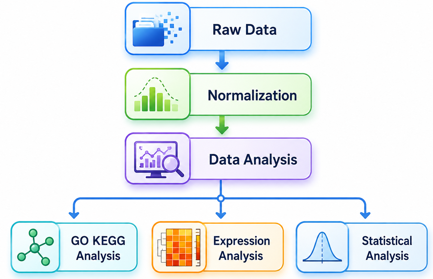
Bioinformatics Analysis We provide multiple customized bioinformatics analyses:
Alignment and TPM/RPKM/FPKM-based quantitation
Expression analysis
Statistics of SNPs/Indels
Alternative splicing analysis
GO and KEGG annotation
…and more
Note: Recommended data outputs and analysis contents displayed are for reference only. For detailed information, please contact us with your customized requests.
Analysis Pipeline
Deliverables
• Raw data
• Experimental results
• Data analysis report
Our full service encompasses the entire process, from initial sample quality control to comprehensive data analysis. Additionally, N2Jenomics Lab Pvt. Ltd. offers the flexibility to design custom microarrays tailored to meet specific project requirements. Should you have any further requirements or questions, please do not hesitate to contact us.
1. How does gene expression profiling differ from RNA sequencing (RNA-seq)? Gene expression microarrays are a reliable and cost-effective solution for measuring the expression of known genes across multiple samples. RNA-seq offers broader transcriptome coverage, enabling the detection of novel transcripts, splice variants, and isoforms, but generally requires higher investment and more complex data analysis.
2. What are the key limitations of gene expression microarrays? One of the primary limitations is probe specificity, which can influence the accuracy of expression measurements. In addition, high-quality RNA and proper sample preparation are essential to minimize technical variation and ensure dependable results.
3. Can gene expression microarray data be combined with other omics datasets? Yes. Microarray gene expression data can be integrated with datasets such as proteomics, metabolomics, and genomics, providing a more comprehensive understanding of biological pathways and molecular interactions.
4. How is efficient probe hybridization ensured, and is probe saturation a concern? Microarray platforms are designed with a large excess of immobilized probes relative to the amount of labeled target RNA. This ensures efficient hybridization while minimizing the risk of probe saturation. In dual-channel microarrays, the probe density is sufficient to support accurate binding of both fluorescently labeled samples.
5. What amount of RNA is required for gene expression microarray analysis? RNA input requirements vary depending on the platform:
• Agilent Gene Expression Microarrays: Minimum 200 ng of total RNA (for both eukaryotic and prokaryotic samples).
• Affymetrix Gene Expression Microarrays: Minimum 250 ng of total RNA.
Address:Registered Office: 138, Patparganj Industrial Area, New Delhi – 110092, India
Operational Address: National Institute of Plant Genome Research (BRIC - NGGF)
Lab No. 206 and 207, Aruna Asaf Ali Marg, P.O. Box No. 10531,
New Delhi – 110067, India